Learn about our science, people, facilities and partners. Discover our history and vision for the future.
Who we are
We explore radically new ideas with an entrepreneurial mindset.
Get an overview of research at SLAC: X-ray and ultrafast science, particle and astrophysics, cosmology, particle accelerators, biology, energy and technology.
Revealing nature’s fastest processes with X-rays, lasers and electrons
Studying the particles and forces that knit the cosmos together
Building smaller, faster, more powerful accelerators for all
Understanding the machinery of life at its most basic level
Inventing new tools for science and society
Finding clean, sustainable solutions for the world’s energy challenges
SLAC science explained
Cut through the jargon while exploring our research.
Learn more about the places where science happens at SLAC: our major facilities, institutes and centers.
Linac Coherent Light Source
Stanford Synchrotron Radiation Lightsource
Facility for Advanced Accelerator Experimental Tests
Cryogenic Electron Microscopy
Stanford Institute for Materials & Energy Science
Kavli Institute for Particle Astrophysics & Cosmology
Stanford PULSE Institute
Center for Interface Science & Catalysis
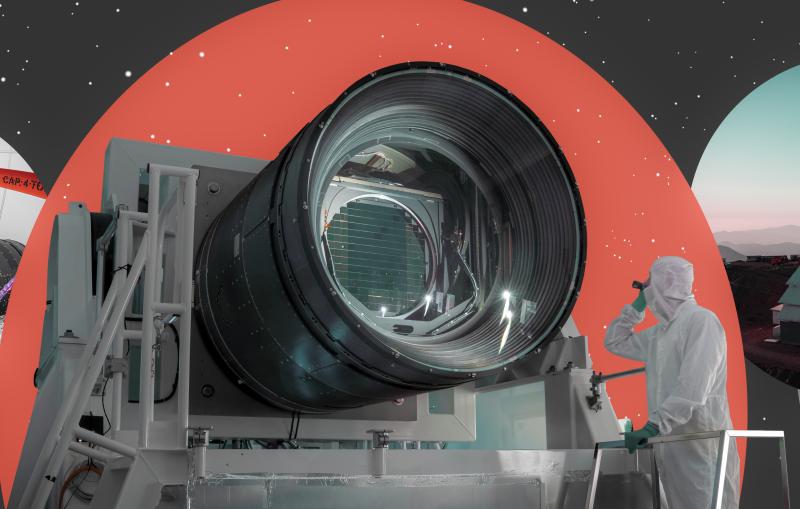
NSF-DOE Vera C. Rubin Observatory LSST
SLAC & Stanford build the world’s largest digital camera for the Legacy Survey of Space and Time (LSST).
Find a career, partner with us or apply to use our tools and facilities.
Apply to become a user of our scientific research facilities and instruments.
Careers at SLAC
Join our united workforce.
Get the latest news about the lab, our science and discoveries. Explore SLAC events and learn how to participate.
This joint publication of SLAC and Fermilab is your view into the world of particle physics.
Reinventing the way we break down plastic waste
Thursday, March 26, 20267:00–8:00 p.m. PDT
Persis Drell and Steven Kivelson have been elected to the National Academy of Sciences, joining 70 other new members and 18 foreign associates in...
A new form of platinum that could be used to make cheaper, more efficient fuel cells has been created by researchers at the Department...
Desktop experiments could point the way to dark matter discovery, complementing grand astronomical searches and deep underground observations.
NSF–DOE Vera C. Rubin Observatory is about to embark on its quest to capture the cosmos, marking the culmination of decades of work by...
With a suite of reimagined instruments, researchers take up scientific inquiries that were out of reach just one year ago.
Ultrafast electrons at SLAC’s LCLS facility resolved the structural changes in a light-activated molecule to determine which simulations work best.
They used SLAC’s ultrafast X-ray laser to follow the impact of a single electron moving within a molecule during an entire chemical reaction.
X-rays unveil new molecular structure details that will help researchers design novel drug therapies to address antibiotic resistant bacteria.
With survey operations set to begin this fall, the Rubin control room at SLAC will serve as a key hub for training and remote...
During a recent shutdown, engineers installed new beamline technology and a 3-D virtual tour captured rare views of the synchrotron’s interior.
The state-of-the-art ‘big-data facility’ unveils its first images and video, bringing the night sky to life like never before.
After a major upgrade, SLAC's X-ray free-electron laser is 10,000 times brighter and thousands of times faster. Now, researchers are using LCLS to observe...