January 29, 2026

X-rays from SLAC's synchrotron reveal star maps in a centuries-old manuscript

Pages from the Codex Climaci Rescriptus palimpsest from the Museum of the Bible in Washington, DC, were brought to the Stanford Synchrotron Radiation Lightsource to recover erased astronomical text, especially fragments from Hipparchus' star catalog.

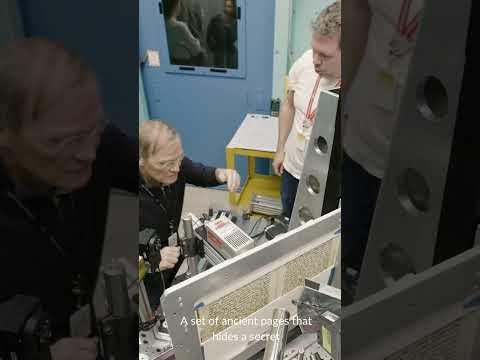
Codex Climaci Rescriptus Palimpsest Scan at SLAC's SSRL
Video

About SLAC

SLAC National Accelerator Laboratory explores how the universe works at the biggest, smallest and fastest scales and invents powerful tools used by researchers around the globe. As world leaders in ultrafast science and bold explorers of the physics of the universe, we forge new ground in understanding our origins and building a healthier and more sustainable future. Our discovery and innovation help develop new materials and chemical processes and open unprecedented views of the cosmos and life’s most delicate machinery. Building on more than 60 years of visionary research, we help shape the future by advancing areas such as quantum technology, scientific computing and the development of next-generation accelerators.

SLAC is operated by Stanford University for the U.S. Department of Energy’s Office of Science. The Office of Science is the single largest supporter of basic research in the physical sciences in the United States and is working to address some of the most pressing challenges of our time.

Dig Deeper

Related stories

News Brief

Using SSRL, scientists uncovered fossil evidence that the first groups of vertebrates possessed surprisingly advanced eyes. 

fossil specimen in gray rock with bright marcations overlain
Feature

Researchers at SLAC are developing experimental techniques to evaluate new candidates for inertial fusion energy targets. 

a graphic in the style of graphic novel depicts four lasers converging on a spherical target, which represents an inertial fusion energy reaction
News Brief
Via Max Planck Institute for Nuclear Physics

Observing quantum footballs blown up by laser kicks

Laser-driven break up of "buckyballs" is recorded in real-time by X-ray imaging at LCLS. 

Buckyballs
News Brief

Using SSRL, scientists uncovered fossil evidence that the first groups of vertebrates possessed surprisingly advanced eyes. 

fossil specimen in gray rock with bright marcations overlain
Feature

Researchers at SLAC are developing experimental techniques to evaluate new candidates for inertial fusion energy targets. 

a graphic in the style of graphic novel depicts four lasers converging on a spherical target, which represents an inertial fusion energy reaction
News Brief
Via Max Planck Institute for Nuclear Physics

Observing quantum footballs blown up by laser kicks

Laser-driven break up of "buckyballs" is recorded in real-time by X-ray imaging at LCLS. 

Buckyballs
News Brief

A new machine learning algorithm rapidly reconstructs 3D images from X-ray data. 

Schematic of a machine learning algorithm that reconstructs 3D images from X-ray data
Feature

With a suite of reimagined instruments, researchers take up scientific inquiries that were out of reach just one year ago. 

Large metallic machine in a lab, featuring valves, circular bolts, and digital displays with surrounding wires and tubing.
News Brief

Results obtained with SLAC’s X-ray laser show how tiny magnetic coils can align over a surprisingly broad timescale, inspiring new ideas for microelectronics. 

Vibrant 3D model with red and blue wave patterns on a layered surface, depicting magnetization points, set against blurry background.