SLAC National Accelerator Laboratory
    • About

      Learn about our science, people, facilities and partners. Discover our history and vision for the future.

    • OUR STORY
      • Mission, vision, values
      • History
    • LAB OVERVIEW
      • SLAC at a glance
      • Lab organization
      • Our partnerships
    • OUR PEOPLE
      • Leadership
      • Meet our teams
      • Faculty
    • VISIT SLAC
      • Public tours
      • Contact us
    • Resources
      • Images, videos & more
      • Brochures & fact sheets
    • Connect With Us
      • Facebook
      • Flickr
      • Instagram
      • LinkedIn
      • Twitter
      • YouTube
    video

    Who we are

    We explore radically new ideas with an entrepreneurial mindset.

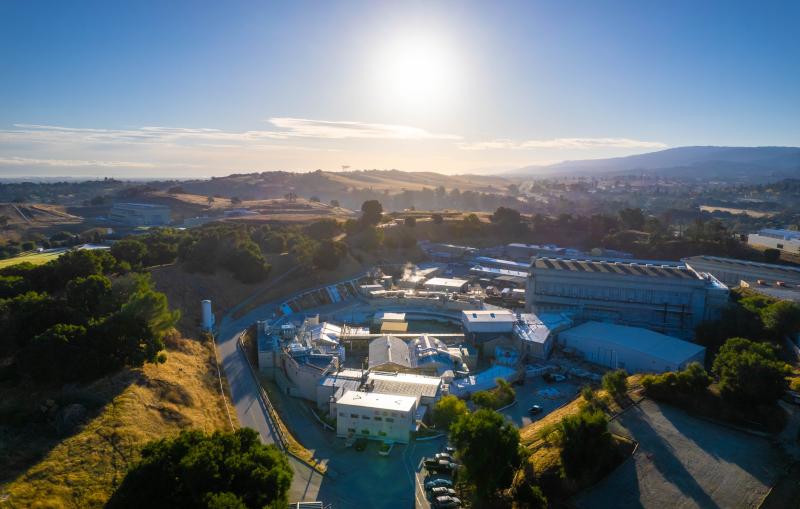
    Science and User Support Building to the left and Arrillaga Science Center building to the right from above the Main Quad at SLAC's campus.
    • Research

      Get an overview of research at SLAC: X-ray and ultrafast science, particle and astrophysics, cosmology, particle accelerators, biology, energy and technology.

    • X-ray and Ultrafast science icon X-ray & ultrafast science

      Revealing nature’s fastest processes with X-rays, lasers and electrons

    • Physics of the universe science icon Physics of the universe

      Studying the particles and forces that knit the cosmos together

    • Advanced Accelerators science icon Advanced accelerators

      Building smaller, faster, more powerful accelerators for all

    • Science of life science icon Science of life

      Understanding the machinery of life at its most basic level

    • New technologies science icon New technologies

      Inventing new tools for science and society

    • Energy sciences science icon Energy sciences

      Finding clean, sustainable solutions for the world’s energy challenges

    Spotlight

    SLAC science explained

    Cut through the jargon while exploring our research.

    SAGE campers have fun experimenting with a Van de Graff generator
    • Facilities & Centers

      Learn more about the places where science happens at SLAC: our major facilities, institutes and centers.

    • SCIENTIFIC FACILITIES
      • LCLS website

        Linac Coherent Light Source

      • SSRL website

        Stanford Synchrotron Radiation Lightsource

      • FACET-II website

        Facility for Advanced Accelerator Experimental Tests

      • CryoEM website

        Cryogenic Electron Microscopy

    • JOINT INSTITUTES & CENTERS
      • SIMES website

        Stanford Institute for Materials & Energy Science

      • KIPAC website

        Kavli Institute for Particle Astrophysics & Cosmology

      • PULSE website

        Stanford PULSE Institute

      • SUNCAT website

        Center for Interface Science & Catalysis

      • SLAC-Stanford Battery Center

    NSF-DOE Vera C. Rubin Observatory LSST

    SLAC & Stanford build the world’s largest digital camera for the Legacy Survey of Space and Time (LSST).

    A drone photo of Rubin Observatory while taking pictures during the First Look observing campaign
    • Work with Us

      Find a career, partner with us or apply to use our tools and facilities.

    • PARTNER WITH US
      • For industry partners
      • Research partnerships & tech transfer
      • Technology Innovation
    • CAREERS AT SLAC
      • Job openings
      • Internships
      • Life at SLAC
    • USE OUR FACILITIES

      Apply to become a user of our scientific research facilities and instruments.

    • COMING TO SLAC
    • BECOME A SUPPLIER

    Careers at SLAC

    Join our united workforce.

    SLAC staff in main quad
    • News & Events

      Get the latest news about the lab, our science and discoveries. Explore SLAC events and learn how to participate.

    • NEWS CENTER
      • News archive
      • Media resources
      • Images & videos
    • SLAC EVENTS
      • Public lectures
      • Scientific seminars
      • Community events
    • SYMMETRY MAGAZINE

      This joint publication of SLAC and Fermilab is your view into the world of particle physics.

    • EDUCATIONAL PROGRAMS
      • Educational tours
      • Resources for students & educators
    • Connect With Us
      • Facebook
      • Flickr
      • Instagram
      • LinkedIn
      • Twitter
      • YouTube
    Upcoming public lecture

    Reinventing the way we break down plastic waste

    Thursday, March 26, 2026
    7:00–8:00 p.m. PDT

    Public Lecture: Ozge Bozkurt
Filter search by
Staff portalStanford directoryComing to SLACResources for…
  1. Home
  2. …
Filter by research area
  • X-ray and ultrafast science (183)
  • Physics of the universe (128)
  • Energy sciences (47)
  • Science of life (29)
  • New technologies (24)
  • Advanced accelerators (10)
Filter by Type
  • (-) News (1773)
  • Image (387)
  • Video (227)
  • Event (157)
  • Page (67)
  • (-) Person (66)
  • resource (64)
  • News Collection (4)
Sort by
1839 results
Display Grid Display List
Clear all
Feature

First SuperCDMS detector towers journey from SLAC to SNOLAB

The first pair of towers are now at the Ontario facility, where they'll further the hunt for dark matter particles.

May 17, 2023  ·  4 min read
SuperCDMS tower
Feature
Via Symmetry Magazine

Searching for the matter that hides its shine

Just because matter is visible doesn’t mean it’s easy to see.

May 16, 2023
Illustration of Earth and galaxies with icons representing telescopes.
Feature
VIA Stanford

New nontoxic powder uses sunlight to quickly disinfect contaminated drinking water

A low-cost, recyclable powder can kill thousands of waterborne bacteria per second when exposed to sunlight. Stanford and SLAC scientists say the ultrafast disinfectant...

May 18, 2023
Four cups of water arranged in a cycle, illustrating a decontamination cycle.
Feature

Kelly Stifter and Julia Gonski awarded 2023 Panofsky Fellowships at SLAC

They’ll work on experiments searching for dark matter and physics beyond the Standard Model of particle physics to push our understanding of what makes...

May 26, 2023  ·  5 min read
Kelly Stifter and Julia Gonski.
Feature

Experiments shed light on pressure-driven ionization in giant planets and stars

The results offer important implications for astrophysics and nuclear fusion research.

May 24, 2023  ·  3 min read
NIF experiment
Feature

In a first, researchers capture fleeting “transition state” in ring-shaped molecules excited by light

The results should further our understanding of similar reactions with vital roles in chemistry, such as the production of vitamin D in our bodies.

May 25, 2023  ·  3 min read
UED transition state
Feature

Q&A: On the road toward cleaner batteries

Batteries come in many shapes and sizes, but their materials can be hard to source. SLAC researchers are trying to build them with more...

June 22, 2023  ·  4 min read
This is a graphic representation of a battery and the things that batteries can power
Feature

DESI early data release holds nearly two million objects

The first batch of data from the Dark Energy Spectroscopic Instrument is now available for researchers to mine. Taken during the experiment’s “survey validation”...

June 13, 2023  ·  5 min read
A telescope building sits atop a mountain in twilight.
Feature

A foundation that fits just right gives superconducting nickelates a boost

It irons out wrinkles in thin films of these novel superconductors so scientists can see their true nature for the first time. 

July 12, 2023  ·  4 min read
Colorized electron microscope images reveal defects in the atomic structure of a nickelate superconductor (right) compared to a defect-free structure (right)
News Brief

Humidity – not just light – causes color degradation in historical paintings, researchers discover

The discovery will help art conservators develop new preservation techniques.

July 6, 2023  ·  3 min read
This image shows a portion of the 17th century painting, “Still Life with Flowers in a Glass Vase,” by Jan Davidszoon de Heem.
Feature

Electrons now moving through the superconducting accelerator that will power SLAC’s X-ray laser

The facility is now one step away from releasing an unprecedented stream of ultra-bright X-rays.

August 7, 2023  ·  5 min read
This is a graphic representation of electron bunches travelling through SLAC's linear accelerator.
SLAC Experts

Johanna Nelson Weker

Lead Scientist, Stanford Synchrotron Radiation Lightsource (SSRL)

Areas of research: X-ray and ultrafast science; energy sciences; X-ray microscopy and X-ray characterization of materials far from equilibrium; energy storage; battery research; 3D...

Headshot of Johanna Nelson Weker
  • Go to previous page
  • Page 1
  • …
  • Page 130
  • Page 131
  • Page 132
  • Page 133
  • Currently on page 134
  • Page 135
  • Page 136
  • Page 137
  • Page 138
  • …
  • Page 154
  • Go to next page

SLAC National Accelerator Laboratory 
2575 Sand Hill Road  
Menlo Park, CA 94025-7015  
650.926.3300

  • Coming to SLAC
  • Connect with us
  • Contact us
  • Facebook
  • Flickr
  • Instagram
  • LinkedIn
  • Twitter
  • YouTube

Sign up for our email

Monthly newsletter for cutting-edge science, SLAC milestones and events.

Sign up

Bold People
Visionary Science
Real Impact

We explore how the universe works at the biggest, smallest and fastest scales and invent powerful tools used by scientists around the globe.

  • About
    • Our story
    • Our people
    • Lab overview
    • Visit SLAC
    • Resources
    • Connect with us
  • Research
    • X-ray & ultrafast science
    • Advanced accelerators
    • New technologies
    • Physics of the universe
    • Science of life
    • Energy sciences
    • SLAC science explained
  • Facilities & centers
    • Scientific facilities
    • Joint institutes & centers
  • Work with us
    • Partner with us
    • Become a supplier
    • Use our facilities
    • Careers at SLAC
  • News & events
    • News center
    • Symmetry Magazine
    • Media resources
    • Events
    • Educational programs
    • Connect with us
  • Staff portal
  • Privacy policy
  • Accessibility
  • Vulnerability disclosure
  • A–Z index
  • Website feedback
Home
  • SLAC home
  • Maps & directions
  • Emergency info
  • Careers

© 2026 SLAC National Accelerator Laboratory is operated by Stanford University for the U.S. Department of Energy Office of Science.

Stanford University U.S. Department of Energy
Top Top
Back to top Back to top