SLAC National Accelerator Laboratory
    • About

      Learn about our science, people, facilities and partners. Discover our history and vision for the future.

    • OUR STORY
      • Mission, vision, values
      • History
    • LAB OVERVIEW
      • SLAC at a glance
      • Lab organization
      • Our partnerships
    • OUR PEOPLE
      • Leadership
      • Meet our teams
      • Faculty
    • VISIT SLAC
      • Public tours
      • Contact us
    • Resources
      • Images, videos & more
      • Brochures & fact sheets
    • Connect With Us
      • Facebook
      • Flickr
      • Instagram
      • LinkedIn
      • Twitter
      • YouTube
    video

    Who we are

    We explore radically new ideas with an entrepreneurial mindset.

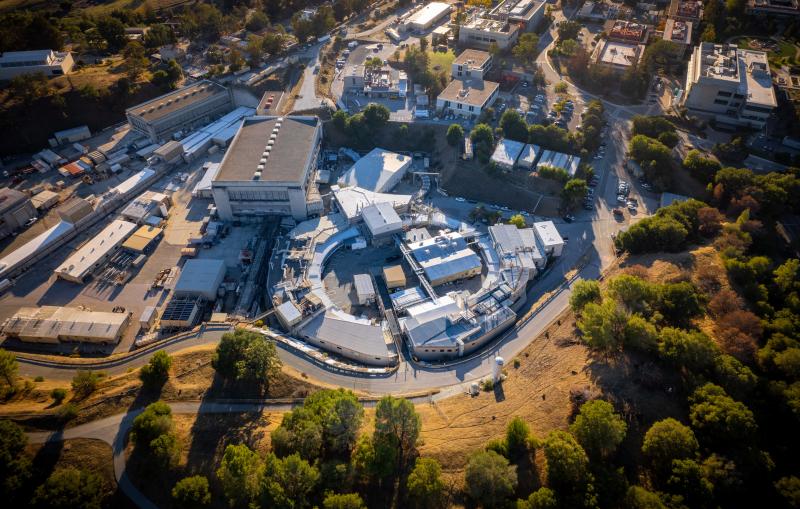
    Science and User Support Building to the left and Arrillaga Science Center building to the right from above the Main Quad at SLAC's campus.
    • Research

      Get an overview of research at SLAC: X-ray and ultrafast science, particle and astrophysics, cosmology, particle accelerators, biology, energy and technology.

    • X-ray and Ultrafast science icon X-ray & ultrafast science

      Revealing nature’s fastest processes with X-rays, lasers and electrons

    • Physics of the universe science icon Physics of the universe

      Studying the particles and forces that knit the cosmos together

    • Advanced Accelerators science icon Advanced accelerators

      Building smaller, faster, more powerful accelerators for all

    • Science of life science icon Science of life

      Understanding the machinery of life at its most basic level

    • New technologies science icon New technologies

      Inventing new tools for science and society

    • Energy sciences science icon Energy sciences

      Finding clean, sustainable solutions for the world’s energy challenges

    Spotlight

    SLAC science explained

    Cut through the jargon while exploring our research.

    SAGE campers have fun experimenting with a Van de Graff generator
    • Facilities & Centers

      Learn more about the places where science happens at SLAC: our major facilities, institutes and centers.

    • SCIENTIFIC FACILITIES
      • LCLS website

        Linac Coherent Light Source

      • SSRL website

        Stanford Synchrotron Radiation Lightsource

      • FACET-II website

        Facility for Advanced Accelerator Experimental Tests

      • CryoEM website

        Cryogenic Electron Microscopy

    • JOINT INSTITUTES & CENTERS
      • SIMES website

        Stanford Institute for Materials & Energy Science

      • KIPAC website

        Kavli Institute for Particle Astrophysics & Cosmology

      • PULSE website

        Stanford PULSE Institute

      • SUNCAT website

        Center for Interface Science & Catalysis

      • SLAC-Stanford Battery Center

    NSF-DOE Vera C. Rubin Observatory LSST

    SLAC & Stanford build the world’s largest digital camera for the Legacy Survey of Space and Time (LSST).

    A drone photo of Rubin Observatory while taking pictures during the First Look observing campaign
    • Work with Us

      Find a career, partner with us or apply to use our tools and facilities.

    • PARTNER WITH US
      • For industry partners
      • Research partnerships & tech transfer
      • Technology Innovation
    • CAREERS AT SLAC
      • Job openings
      • Internships
      • Life at SLAC
    • USE OUR FACILITIES

      Apply to become a user of our scientific research facilities and instruments.

    • COMING TO SLAC
    • BECOME A SUPPLIER

    Careers at SLAC

    Join our united workforce.

    SLAC staff in main quad
    • News & Events

      Get the latest news about the lab, our science and discoveries. Explore SLAC events and learn how to participate.

    • NEWS CENTER
      • News archive
      • Media resources
      • Images & videos
    • SLAC EVENTS
      • Public lectures
      • Scientific seminars
      • Community events
    • SYMMETRY MAGAZINE

      This joint publication of SLAC and Fermilab is your view into the world of particle physics.

    • EDUCATIONAL PROGRAMS
      • Educational tours
      • Resources for students & educators
    • Connect With Us
      • Facebook
      • Flickr
      • Instagram
      • LinkedIn
      • Twitter
      • YouTube
    Upcoming public lecture

    Reinventing the way we break down plastic waste

    Thursday, March 26, 2026
    7:00–8:00 p.m. PDT

    Public Lecture: Ozge Bozkurt
Filter search by
Staff portalStanford directoryComing to SLACResources for…
  1. Home
  2. …
Filter by research area
  • X-ray and ultrafast science (183)
  • Physics of the universe (129)
  • Energy sciences (47)
  • Science of life (29)
  • New technologies (24)
  • Advanced accelerators (10)
Filter by Type
  • (-) News (1774)
  • Image (387)
  • Video (227)
  • Event (157)
  • Page (67)
  • (-) Person (66)
  • resource (64)
  • News Collection (4)
Sort by
1840 results
Display Grid Display List
Clear all
News Release

Jonathan Dorfan, SLAC Professor and Director Emeritus, to Lead New Graduate University in Japan

Dr. Jonathan Dorfan has been named president-elect of the Okinawa Institute of Science and Technology (OIST) Graduate University.

July 9, 2010
Jonathan Dorfan
News Release

First Results from the LCLS: Unpeeling Atoms and Molecules from the Inside Out

The first published scientific results from the world's most powerful hard X-ray laser, located at the Department of Energy's SLAC National Accelerator Laboratory, show...

June 30, 2010
Illustration of X-ray laser pulses stripping electrons away from atoms
News Release

X-Rays Reveal Chemical Link Between Birds and Dinosaurs

Researchers have found that a 150 million year old "dinobird" fossil, long thought to contain nothing but fossilized bone and rock, has been hiding...

May 10, 2010
A false color image of the Thermopolis Archaeopteryx
News Release

First X-ray Laser's Early Success Brings Approval for Next-phase Facility

The U.S. Department of Energy has granted approval for SLAC National Accelerator Laboratory—home of the Linac Coherent Light Source (LCLS), the world's first hard...

May 5, 2010
Undulator Hall
News Release

SLAC Scientists Elected to National Academy of Sciences

Persis Drell and Steven Kivelson have been elected to the National Academy of Sciences, joining 70 other new members and 18 foreign associates in...

April 28, 2010
SLAC logo
News Release

Fuel Cells Get Up to Speed with a New Kind of Platinum

A new form of platinum that could be used to make cheaper, more efficient fuel cells has been created by researchers at the Department...

April 26, 2010
Researchers including Hirohito Ogasawara (left), Anders Nilsson (center), and Mike Toney
News Release

Seeking Dark Matter on a Desktop

Desktop experiments could point the way to dark matter discovery, complementing grand astronomical searches and deep underground observations.

March 15, 2010
Photo - Shoucheng Zhang
Feature

Lights, camera, cosmos: the cast and crew behind Rubin Observatory

NSF–DOE Vera C. Rubin Observatory is about to embark on its quest to capture the cosmos, marking the culmination of decades of work by...

June 12, 2025  ·  12 min read
A group photo in front of a large telescope mounting system.
Feature

The United States just got a new X-ray laser toolkit to study nature’s mysteries

With a suite of reimagined instruments, researchers take up scientific inquiries that were out of reach just one year ago. 

August 7, 2025  ·  7 min read
Large metallic machine in a lab, featuring valves, circular bolts, and digital displays with surrounding wires and tubing.
Feature

SLAC researchers help organize community challenge to benchmark molecular simulations with experiments

Ultrafast electrons at SLAC’s LCLS facility resolved the structural changes in a light-activated molecule to determine which simulations work best. 

July 16, 2025  ·  4 min read
Graphic representation of several molecules floating through space, circle of papers representing scientific results
Feature

Researchers track the motion of a single electron during a chemical reaction

They used SLAC’s ultrafast X-ray laser to follow the impact of a single electron moving within a molecule during an entire chemical reaction.

August 20, 2025  ·  4 min read
An illustration of X-rays scattering off the valence electrons surrounding ammonia molecules and getting captured on a detector.
SLAC EXPERTS

Simon R. Bare

Co-Director of Chemistry & Catalysis Division, Stanford Synchrotron Radiation Lightsource (SSRL); Distinguished Staff Scientist, SLAC National Accelerator Laboratory (SLAC)

Areas of research: X-ray absorption spectroscopy, operando catalyst characterization, catalyst structure-property relationships, new methods of catalyst characterization

Portrait of Simon R Bare
  • Go to previous page
  • Page 1
  • …
  • Page 120
  • Page 121
  • Page 122
  • Page 123
  • Currently on page 124
  • Page 125
  • Page 126
  • Page 127
  • Page 128
  • …
  • Page 154
  • Go to next page

SLAC National Accelerator Laboratory 
2575 Sand Hill Road  
Menlo Park, CA 94025-7015  
650.926.3300

  • Coming to SLAC
  • Connect with us
  • Contact us
  • Facebook
  • Flickr
  • Instagram
  • LinkedIn
  • Twitter
  • YouTube

Sign up for our email

Monthly newsletter for cutting-edge science, SLAC milestones and events.

Sign up

Bold People
Visionary Science
Real Impact

We explore how the universe works at the biggest, smallest and fastest scales and invent powerful tools used by scientists around the globe.

  • About
    • Our story
    • Our people
    • Lab overview
    • Visit SLAC
    • Resources
    • Connect with us
  • Research
    • X-ray & ultrafast science
    • Advanced accelerators
    • New technologies
    • Physics of the universe
    • Science of life
    • Energy sciences
    • SLAC science explained
  • Facilities & centers
    • Scientific facilities
    • Joint institutes & centers
  • Work with us
    • Partner with us
    • Become a supplier
    • Use our facilities
    • Careers at SLAC
  • News & events
    • News center
    • Symmetry Magazine
    • Media resources
    • Events
    • Educational programs
    • Connect with us
  • Staff portal
  • Privacy policy
  • Accessibility
  • Vulnerability disclosure
  • A–Z index
  • Website feedback
Home
  • SLAC home
  • Maps & directions
  • Emergency info
  • Careers

© 2026 SLAC National Accelerator Laboratory is operated by Stanford University for the U.S. Department of Energy Office of Science.

Stanford University U.S. Department of Energy
Top Top
Back to top Back to top