SLAC National Accelerator Laboratory
    • About

      Learn about our science, people, facilities and partners. Discover our history and vision for the future.

    • OUR STORY
      • Mission, vision, values
      • History
    • LAB OVERVIEW
      • SLAC at a glance
      • Lab organization
      • Our partnerships
    • OUR PEOPLE
      • Leadership
      • Meet our teams
      • Faculty
    • VISIT SLAC
      • Public tours
      • Contact us
    • Resources
      • Images, videos & more
      • Brochures & fact sheets
    • Connect With Us
      • Facebook
      • Flickr
      • Instagram
      • LinkedIn
      • Twitter
      • YouTube
    video

    Who we are

    We explore radically new ideas with an entrepreneurial mindset.

    Science and User Support Building to the left and Arrillaga Science Center building to the right from above the Main Quad at SLAC's campus.
    • Research

      Get an overview of research at SLAC: X-ray and ultrafast science, particle and astrophysics, cosmology, particle accelerators, biology, energy and technology.

    • X-ray and Ultrafast science icon X-ray & ultrafast science

      Revealing nature’s fastest processes with X-rays, lasers and electrons

    • Physics of the universe science icon Physics of the universe

      Studying the particles and forces that knit the cosmos together

    • Advanced Accelerators science icon Advanced accelerators

      Building smaller, faster, more powerful accelerators for all

    • Science of life science icon Science of life

      Understanding the machinery of life at its most basic level

    • New technologies science icon New technologies

      Inventing new tools for science and society

    • Energy sciences science icon Energy sciences

      Finding clean, sustainable solutions for the world’s energy challenges

    Spotlight

    SLAC science explained

    Cut through the jargon while exploring our research.

    SAGE campers have fun experimenting with a Van de Graff generator
    • Facilities & Centers

      Learn more about the places where science happens at SLAC: our major facilities, institutes and centers.

    • SCIENTIFIC FACILITIES
      • LCLS website

        Linac Coherent Light Source

      • SSRL website

        Stanford Synchrotron Radiation Lightsource

      • FACET-II website

        Facility for Advanced Accelerator Experimental Tests

      • CryoEM website

        Cryogenic Electron Microscopy

    • JOINT INSTITUTES & CENTERS
      • SIMES website

        Stanford Institute for Materials & Energy Science

      • KIPAC website

        Kavli Institute for Particle Astrophysics & Cosmology

      • PULSE website

        Stanford PULSE Institute

      • SUNCAT website

        Center for Interface Science & Catalysis

      • SLAC-Stanford Battery Center

    NSF-DOE Vera C. Rubin Observatory LSST

    SLAC & Stanford build the world’s largest digital camera for the Legacy Survey of Space and Time (LSST).

    A drone photo of Rubin Observatory while taking pictures during the First Look observing campaign
    • Work with Us

      Find a career, partner with us or apply to use our tools and facilities.

    • PARTNER WITH US
      • For industry partners
      • Research partnerships & tech transfer
      • Technology Innovation
    • CAREERS AT SLAC
      • Job openings
      • Internships
      • Life at SLAC
    • USE OUR FACILITIES

      Apply to become a user of our scientific research facilities and instruments.

    • COMING TO SLAC
    • BECOME A SUPPLIER

    Careers at SLAC

    Join our united workforce.

    SLAC staff in main quad
    • News & Events

      Get the latest news about the lab, our science and discoveries. Explore SLAC events and learn how to participate.

    • NEWS CENTER
      • News archive
      • Media resources
      • Images & videos
    • SLAC EVENTS
      • Public lectures
      • Scientific seminars
      • Community events
    • SYMMETRY MAGAZINE

      This joint publication of SLAC and Fermilab is your view into the world of particle physics.

    • EDUCATIONAL PROGRAMS
      • Educational tours
      • Resources for students & educators
    • Connect With Us
      • Facebook
      • Flickr
      • Instagram
      • LinkedIn
      • Twitter
      • YouTube
    Upcoming public lecture

    Reinventing the way we break down plastic waste

    Thursday, March 26, 2026
    7:00–8:00 p.m. PDT

    Public Lecture: Ozge Bozkurt
Filter search by
Staff portalStanford directoryComing to SLACResources for…
  1. Home
  2. …
Filter by research area
  • X-ray and ultrafast science (183)
  • Physics of the universe (129)
  • Energy sciences (47)
  • Science of life (29)
  • New technologies (24)
  • Advanced accelerators (10)
Filter by Type
  • (-) News (1774)
  • Image (387)
  • Video (227)
  • Event (157)
  • Page (67)
  • (-) Person (66)
  • resource (64)
  • News Collection (4)
Sort by
1840 results
Display Grid Display List
Clear all
Feature

SLAC joins new LaserNetUS network to boost high-intensity laser research

The initiative will give scientists more access to powerful lasers at universities and labs.

October 30, 2018  ·  3 min read
MEC LaserNet
Feature

Scientists make first detailed measurements of key factors related to high-temperature superconductivity

Two studies led by SLAC and Stanford capture electron 'sound waves' and identify a positive feedback loop that may boost superconducting temperatures.

October 31, 2018  ·  6 min read
Illustration of study that reveals how coordinated motions of atoms boost superconductivity
Feature

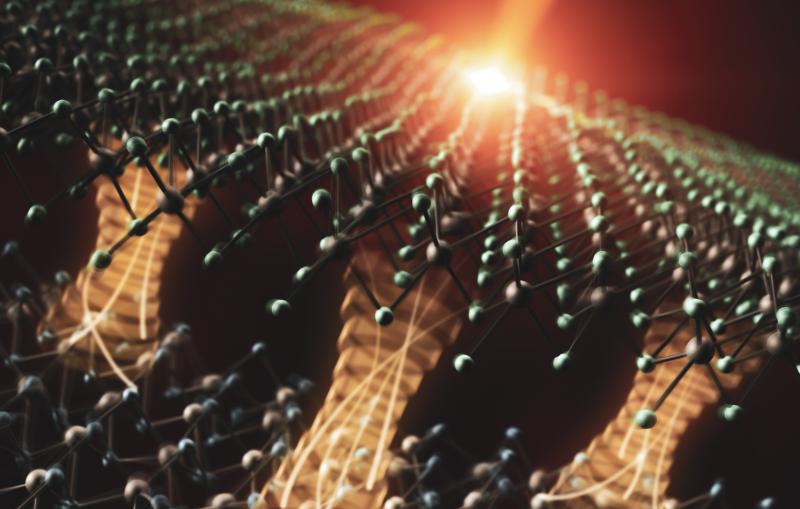
In materials hit with light, individual atoms and vibrations take disorderly paths

Revealed for the first time by a new X-ray laser technique, their surprisingly unruly response has profound implications for designing and controlling materials.

November 1, 2018  ·  7 min read
Illustration of laser light setting off vibrations in material
Feature

Dancing atoms in perovskite materials provide insight into how solar cells work

A new study is a step forward in understanding why perovskite materials work so well in energy devices and potentially leads the way toward...

November 6, 2018  ·  5 min read
Scattered neutrons off perovskite material.
News Release

Researchers create most complete high-res atomic movie of photosynthesis to date

In a major step forward, SLAC’s X-ray laser captures all four stable states of the process that produces the oxygen we breathe, as well...

November 7, 2018  ·  7 min read
Atomic movie
Feature

X-rays show how periods of stress changed an ice age hyena to the bone

Researchers mapped trace elements within Pleistocene fossils to learn about the life of a long-extinct subspecies of spotted hyena.

November 13, 2018  ·  5 min read
Spotted hyena
Feature
VIA Symmetry Magazine

Gravitational lenses

Predicted by Einstein and discovered in 1979, gravitational lensing helps astrophysicists understand the evolving shape of the universe.

November 13, 2018
News Release

The future of fighting cancer: zapping tumors in less than a second

SLAC and Stanford researchers secure support for two projects that share one goal: to reduce the side effects of radiation therapy by vastly shrinking...

November 28, 2018  ·  5 min read
Researchers at SLAC and Stanford are developing new accelerator-based technology that aims to speed up cancer radiation therapy.
Feature

To curb maternal deaths in developing countries, researchers use X-rays to map a lifesaving drug in action

New research will help in the quest to design low-cost drugs that can tackle postpartum bleeding and other conditions without severe side effects.

December 3, 2018  ·  4 min read
Misoprostol and EP3 receptor
Feature
VIA Symmetry Magazine

LHC ends second season of data-taking

During the last four years, LHC scientists have filled in gaps in our knowledge and tested the boundaries of the Standard Model.

December 3, 2018
Photo LHC Second Season
Feature
VIA Stanford News

Theoretical physicist Shoucheng Zhang dies at 55

The SIMES researcher was a rare theorist who concerned himself with the implications of his abstract ideas about new quantum states of matter on...

December 6, 2018
Shoucheng Zhang
News Release

Tangled magnetic fields power cosmic particle accelerators

SLAC scientists find a new way to explain how a black hole’s plasma jets boost particles to the highest energies observed in the universe...

December 13, 2018  ·  4 min read
Cosmic particle accelerators
  • Go to previous page
  • Page 1
  • …
  • Page 99
  • Page 100
  • Page 101
  • Page 102
  • Currently on page 103
  • Page 104
  • Page 105
  • Page 106
  • Page 107
  • …
  • Page 154
  • Go to next page

SLAC National Accelerator Laboratory 
2575 Sand Hill Road  
Menlo Park, CA 94025-7015  
650.926.3300

  • Coming to SLAC
  • Connect with us
  • Contact us
  • Facebook
  • Flickr
  • Instagram
  • LinkedIn
  • Twitter
  • YouTube

Sign up for our email

Monthly newsletter for cutting-edge science, SLAC milestones and events.

Sign up

Bold People
Visionary Science
Real Impact

We explore how the universe works at the biggest, smallest and fastest scales and invent powerful tools used by scientists around the globe.

  • About
    • Our story
    • Our people
    • Lab overview
    • Visit SLAC
    • Resources
    • Connect with us
  • Research
    • X-ray & ultrafast science
    • Advanced accelerators
    • New technologies
    • Physics of the universe
    • Science of life
    • Energy sciences
    • SLAC science explained
  • Facilities & centers
    • Scientific facilities
    • Joint institutes & centers
  • Work with us
    • Partner with us
    • Become a supplier
    • Use our facilities
    • Careers at SLAC
  • News & events
    • News center
    • Symmetry Magazine
    • Media resources
    • Events
    • Educational programs
    • Connect with us
  • Staff portal
  • Privacy policy
  • Accessibility
  • Vulnerability disclosure
  • A–Z index
  • Website feedback
Home
  • SLAC home
  • Maps & directions
  • Emergency info
  • Careers

© 2026 SLAC National Accelerator Laboratory is operated by Stanford University for the U.S. Department of Energy Office of Science.

Stanford University U.S. Department of Energy
Top Top
Back to top Back to top