Learn about our science, people, facilities and partners. Discover our history and vision for the future.
Who we are
We explore radically new ideas with an entrepreneurial mindset.
Get an overview of research at SLAC: X-ray and ultrafast science, particle and astrophysics, cosmology, particle accelerators, biology, energy and technology.
Revealing nature’s fastest processes with X-rays, lasers and electrons
Studying the particles and forces that knit the cosmos together
Building smaller, faster, more powerful accelerators for all
Understanding the machinery of life at its most basic level
Inventing new tools for science and society
Finding clean, sustainable solutions for the world’s energy challenges
SLAC science explained
Cut through the jargon while exploring our research.
Learn more about the places where science happens at SLAC: our major facilities, institutes and centers.
Linac Coherent Light Source
Stanford Synchrotron Radiation Lightsource
Facility for Advanced Accelerator Experimental Tests
Cryogenic Electron Microscopy
Stanford Institute for Materials & Energy Science
Kavli Institute for Particle Astrophysics & Cosmology
Stanford PULSE Institute
Center for Interface Science & Catalysis
NSF-DOE Vera C. Rubin Observatory LSST
SLAC & Stanford build the world’s largest digital camera for the Legacy Survey of Space and Time (LSST).
Find a career, partner with us or apply to use our tools and facilities.
Apply to become a user of our scientific research facilities and instruments.
Careers at SLAC
Join our united workforce.
Get the latest news about the lab, our science and discoveries. Explore SLAC events and learn how to participate.
This joint publication of SLAC and Fermilab is your view into the world of particle physics.
STEM Community Day 2026
Saturday, September 12
Most experiments searching for mysterious dark matter require massive colliders, but Stanford physicist and SLAC collaborator Peter Graham advocates a different, less costly approach.
How can we measure the worth of scientific knowledge? Economic analysts give it a shot.
Kelly Gaffney is the director of SSRL, SLAC's synchrotron that produces extremely bright x-rays as a resource for researchers to study our world at...
Neutron stars have earned their share of superlatives since their discovery in 1967.
After 50 Years of Operation, One-third of the Lab’s Historic Linear Accelerator Is Extracted to Build Powerful New X-Ray Laser
The contaminant binds to organic matter in sediments, which increases persistence in groundwater.
An ancient surprise surfaced in 1964 during construction of the 2-mile linear accelerator.
Think you can do better than the Symmetry staff? Send us your poems!
Construction has officially launched for the LZ next-generation dark matter experiment.
Advance your romance with science.
H. Pierre Noyes, the first director of SLAC's Theory Group, died in Stanford on Sept. 30, 2016, at age 92. Noyes, a theoretical physicist...
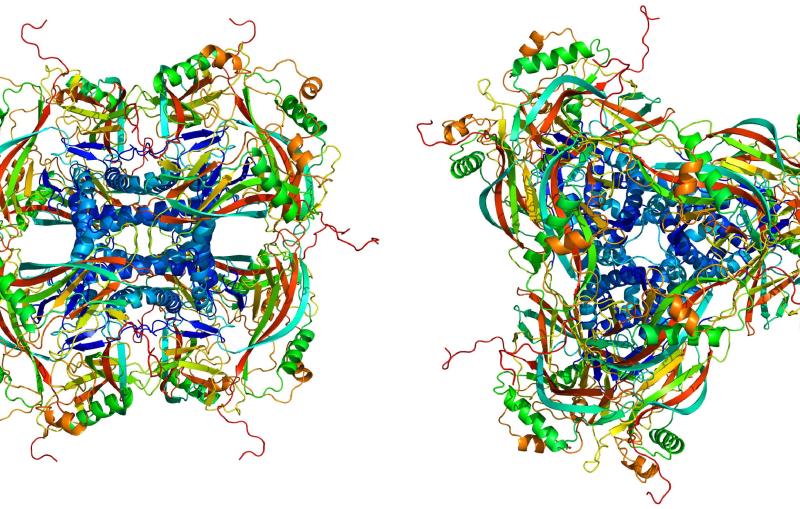
X-rays show details of an insect virus’s crystalline cocoon with sub-nanometer resolution.