SLAC National Accelerator Laboratory
    • About

      Learn about our science, people, facilities and partners. Discover our history and vision for the future.

    • OUR STORY
      • Mission, vision, values
      • History
    • LAB OVERVIEW
      • SLAC at a glance
      • Lab organization
      • Our partnerships
    • OUR PEOPLE
      • Leadership
      • Meet our teams
      • Faculty
    • VISIT SLAC
      • Public tours
      • Contact us
    • Resources
      • Images, videos & more
      • Brochures & fact sheets
    • Connect With Us
      • Facebook
      • Flickr
      • Instagram
      • LinkedIn
      • Twitter
      • YouTube
    video

    Who we are

    We explore radically new ideas with an entrepreneurial mindset.

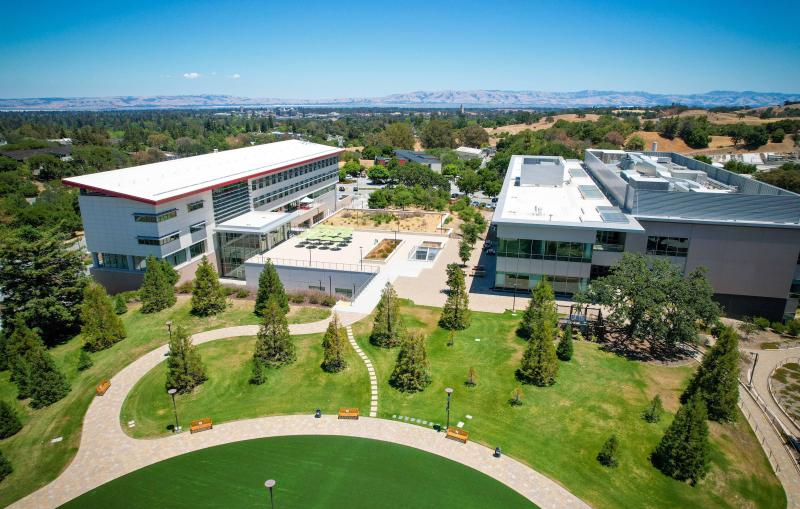
    Science and User Support Building to the left and Arrillaga Science Center building to the right from above the Main Quad at SLAC's campus.
    • Research

      Get an overview of research at SLAC: X-ray and ultrafast science, particle and astrophysics, cosmology, particle accelerators, biology, energy and technology.

    • X-ray and Ultrafast science icon X-ray & ultrafast science

      Revealing nature’s fastest processes with X-rays, lasers and electrons

    • Physics of the universe science icon Physics of the universe

      Studying the particles and forces that knit the cosmos together

    • Advanced Accelerators science icon Advanced accelerators

      Building smaller, faster, more powerful accelerators for all

    • Science of life science icon Science of life

      Understanding the machinery of life at its most basic level

    • New technologies science icon New technologies

      Inventing new tools for science and society

    • Energy sciences science icon Energy sciences

      Finding clean, sustainable solutions for the world’s energy challenges

    Spotlight

    SLAC science explained

    Cut through the jargon while exploring our research.

    SAGE campers have fun experimenting with a Van de Graff generator
    • Facilities & Centers

      Learn more about the places where science happens at SLAC: our major facilities, institutes and centers.

    • SCIENTIFIC FACILITIES
      • LCLS website

        Linac Coherent Light Source

      • SSRL website

        Stanford Synchrotron Radiation Lightsource

      • FACET-II website

        Facility for Advanced Accelerator Experimental Tests

      • CryoEM website

        Cryogenic Electron Microscopy

    • JOINT INSTITUTES & CENTERS
      • SIMES website

        Stanford Institute for Materials & Energy Science

      • KIPAC website

        Kavli Institute for Particle Astrophysics & Cosmology

      • PULSE website

        Stanford PULSE Institute

      • SUNCAT website

        Center for Interface Science & Catalysis

      • SLAC-Stanford Battery Center

    NSF-DOE Vera C. Rubin Observatory LSST

    SLAC & Stanford build the world’s largest digital camera for the Legacy Survey of Space and Time (LSST).

    A drone photo of Rubin Observatory while taking pictures during the First Look observing campaign
    • Work with Us

      Find a career, partner with us or apply to use our tools and facilities.

    • PARTNER WITH US
      • For industry partners
      • Research partnerships & tech transfer
      • Technology Innovation
    • CAREERS AT SLAC
      • Job openings
      • Internships
      • Life at SLAC
    • USE OUR FACILITIES

      Apply to become a user of our scientific research facilities and instruments.

    • COMING TO SLAC
    • BECOME A SUPPLIER

    Careers at SLAC

    Join our united workforce.

    SLAC staff in main quad
    • News & Events

      Get the latest news about the lab, our science and discoveries. Explore SLAC events and learn how to participate.

    • NEWS CENTER
      • News archive
      • Media resources
      • Images & videos
    • SLAC EVENTS
      • Public lectures
      • Scientific seminars
      • Community events
    • SYMMETRY MAGAZINE

      This joint publication of SLAC and Fermilab is your view into the world of particle physics.

    • EDUCATIONAL PROGRAMS
      • Educational tours
      • Resources for students & educators
    • Connect With Us
      • Facebook
      • Flickr
      • Instagram
      • LinkedIn
      • Twitter
      • YouTube
    Spotlight

    SLAC events

    Event attendees listen to a science lecture
Filter search by
Staff portalStanford directoryComing to SLACResources for…
  1. Home
  2. …
Filter by research area
  • X-ray and ultrafast science (258)
  • Physics of the universe (190)
  • Energy sciences (64)
  • Science of life (55)
  • Advanced accelerators (33)
  • New technologies (33)
Filter by Type
  • (-) News (1787)
  • (-) Image (387)
  • Video (228)
  • Event (159)
  • Page (67)
  • Person (67)
  • resource (64)
  • News Collection (5)
Sort by
2174 results
Display Grid Display List
Clear all
Feature

Ming Yi wins Spicer Award for superconductor research at SLAC’s X-ray synchrotron

Former Stanford and UC-Berkeley physicist is honored for foundational research that peers into unconventional phenomena within exotic materials.

July 30, 2018  ·  5 min read
Photo: Ming Yi
Feature

Risa Wechsler named director of KIPAC

She’ll direct the future of astrophysics research at SLAC and Stanford for the next five years.

July 31, 2018  ·  3 min read
Risa Wechsler 2018
Feature

Particle physicists team up with AI to solve toughest science problems

Researchers from SLAC and around the world increasingly use machine learning to handle Big Data produced in modern experiments and to study some of...

August 1, 2018  ·  6 min read
Machine Learning in HEP
Feature

In a first, scientists precisely measure how synthetic diamonds grow

A SLAC-Stanford study reveals exactly what it takes for diamond to crystallize around a “seed” cluster of atoms. The results apply to industrial processes...

August 2, 2018  ·  5 min read
Illustration of diamondoid and diamond crystals
Feature

Catching the dance of antibiotics and ribosomes at room temperature

A new imaging technique is allowing researchers to pinpoint ways of modifying drugs to avoid side effects.

August 6, 2018  ·  7 min read
Hasan DeMirci Ribosome
Feature

46th annual SLAC Summer Institute celebrates Standard Model at 50

The event attracted 124 participants and explores the successes and challenges of the theory that describes subatomic particles and fundamental forces.

August 7, 2018  ·  2 min read
SSI 2018
Feature

Winning photos from the 2018 SLAC physics photowalk

The SLAC Photowalk took a group of photographers, both amateur and professional, behind the scenes to photograph SLAC's world-class science facilities, including the world's...

August 27, 2018
Photowalk: CXI chamber
Feature

Students affected by Hurricane Maria bring their research to SLAC

This summer, five graduate students from the University of Puerto Rico had the opportunity to use SLAC’s world-class facilities to keep their studies on...

August 21, 2018  ·  5 min read
University of Puerto Rico Interns
Feature

How SLAC’s ‘electronics artists’ enable cutting-edge science

A team of electrical designers develops specialized microchips for a broad range of scientific applications, including X-ray science and particle physics.

August 23, 2018  ·  7 min read
This illustration shows the layout of an application-specific integrated circuit, or ASIC, at an imaginary art exhibition.
Feature

Q&A: Shining X-ray light on perovskites for better solar cells

Four scientists discuss X-ray experiments at SLAC’s synchrotron that reveal new insights into how a promising solar cell material forms.

August 27, 2018  ·  6 min read
Photo: Aryeh Gold-Parker, Chris Tassone, Kevin Stone and Mike Toney
Feature
VIA Symmetry Magazine

LHC scientists detect most favored Higgs decay

Today the ATLAS collaboration, which includes SLAC physicists, announced with the CMS collaboration the joint discovery of the Higgs boson transforming into bottom quarks...

August 28, 2018
Feature

Chuntian Cao wins 2018 Klein Award for lithium-ion battery research

Using SLAC’s X-ray synchrotron SSRL, Cao improves fundamental knowledge about how a new lithium-ion battery material works, which will help enable safer, longer-lasting devices.

August 30, 2018  ·  3 min read
Chuntian Cao
  • Go to previous page
  • Page 1
  • …
  • Page 128
  • Page 129
  • Page 130
  • Page 131
  • Currently on page 132
  • Page 133
  • Page 134
  • Page 135
  • Page 136
  • …
  • Page 182
  • Go to next page

SLAC National Accelerator Laboratory 
2575 Sand Hill Road  
Menlo Park, CA 94025-7015  
650.926.3300

  • Coming to SLAC
  • Connect with us
  • Contact us
  • Facebook
  • Flickr
  • Instagram
  • LinkedIn
  • Twitter
  • YouTube

Sign up for our email

Monthly newsletter for cutting-edge science, SLAC milestones and events.

Sign up

Bold People
Visionary Science
Real Impact

We explore how the universe works at the biggest, smallest and fastest scales and invent powerful tools used by scientists around the globe.

  • About
    • Our story
    • Our people
    • Lab overview
    • Visit SLAC
    • Resources
    • Connect with us
  • Research
    • X-ray & ultrafast science
    • Advanced accelerators
    • New technologies
    • Physics of the universe
    • Science of life
    • Energy sciences
    • SLAC science explained
  • Facilities & centers
    • Scientific facilities
    • Joint institutes & centers
  • Work with us
    • Partner with us
    • Become a supplier
    • Use our facilities
    • Careers at SLAC
  • News & events
    • News center
    • Symmetry Magazine
    • Media resources
    • Events
    • Educational programs
    • Connect with us
  • Staff portal
  • Privacy policy
  • Accessibility
  • Vulnerability disclosure
  • A–Z index
  • Website feedback
Home
  • SLAC home
  • Maps & directions
  • Emergency info
  • Careers

© 2026 SLAC National Accelerator Laboratory is operated by Stanford University for the U.S. Department of Energy Office of Science.

Stanford University U.S. Department of Energy
Top Top
Back to top Back to top