Researchers discover they contain a phase of quantum matter, known as charge density waves, that’s common in other unconventional superconductors. In other ways, though, they’re surprisingly unique.
After almost two decades of synchrotron experiments, Caltech scientists have captured a clear picture of a cell’s nuclear pores, which are the doors and windows through which critical material in your body flows in and out of the cell’s nucleus...
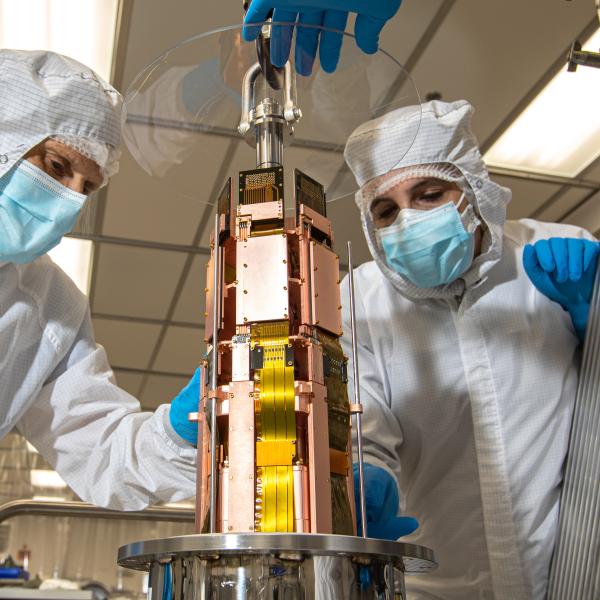
SLAC researchers contributed to the design, construction, testing and analysis of the experiment, which has already put the tightest bounds yet on a popular theory of dark matter.
They’ll work on experiments that search for dark matter particles and exotic neutrino decays that could help explain why there’s more matter than antimatter in the universe.
An extension of the Stanford Research Computing Facility will host several data centers to handle the unprecedented data streams that will be produced by a new generation of scientific projects.
Waves of magnetic excitation sweep through this exciting new material whether it’s in superconducting mode or not – another possible clue to how unconventional superconductors carry electric current with no loss.
To capture as much information as possible about clouds of atoms at the heart of the MAGIS-100 experiment, SLAC scientists devised a dome of mirrors that gathers more light from more angles.
SLAC works with two small businesses to make its ACE3P software easier to use in supercomputer simulations for optimizing the shapes of accelerator structures.
En route to record-breaking X-rays, SLAC’s Cryogenic team built a helium-refrigeration plant that lowers the LCLS-II accelerator to superconducting temperatures.