The Rubin Observatory's LSST Camera will take enormously detailed images of the night sky from atop a mountain in Chile. Down below the mountain, high-speed computers will send the data out into the world. What happens in between?
Vera C. Rubin Observatory’s Legacy Survey of Space and Time will revolutionize Solar System science by revealing a population of previously undiscovered interstellar comets and asteroids passing through our cosmic neighborhood.
Vera C. Rubin Observatory’s fast-moving telescope and huge digital camera will illuminate the faint glow of free-floating stars within galaxy clusters, providing unprecedented insight into the evolution of these dynamic structures.
The 3.5-meter glass mirror is the first permanent component of the Simonyi Survey Telescope's state-of-the-art, wide-field optical system to be installed and will soon contribute to a better understanding of our Universe.
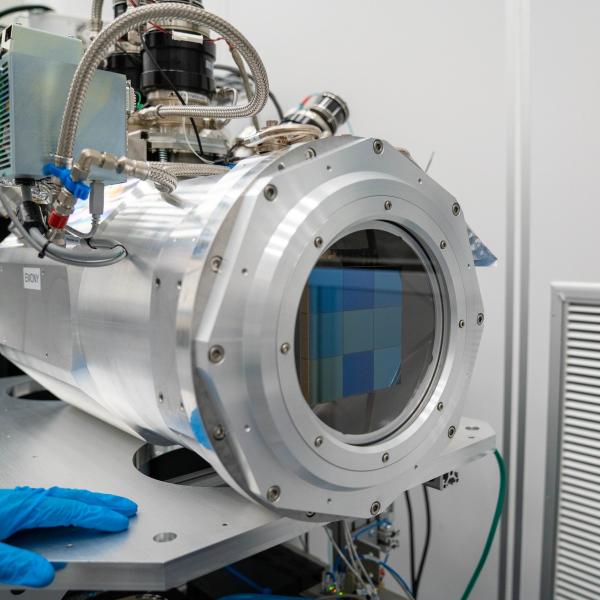
LSST is currently under construction in Chile. The U.S. Department of Energy’s SLAC National Accelerator Laboratory is leading the construction of the LSST camera – the largest digital camera ever built for astronomy.
NSF-DOE Rubin Observatory has issued its first scientific alerts, marking a historic milestone in astrophysics and kicking off a new era of dynamic, real-time observation of the night sky.
The world’s biggest digital camera was built at SLAC, and shipped to the NSF-DOE Vera C. Rubin Observatory in northern Chile last year. This observatory has a goal no less ambitious than to map the entire the southern sky and...
SLAC scientists played key roles in leadership, survey design, cosmological applications, studies of dark matter and of links to the cosmic microwave background.