
SLAC National Accelerator Laboratory
    • About

      Learn about our science, people, facilities and partners. Discover our history and vision for the future.

    • OUR STORY
      • Mission, vision, values
      • History
    • LAB OVERVIEW
      • SLAC at a glance
      • Lab organization
      • Our partnerships
    • OUR PEOPLE
      • Leadership
      • Meet our teams
      • Faculty
    • VISIT SLAC
      • Public tours
      • Contact us
    • Resources
      • Images, videos & more
      • Brochures & fact sheets
    • Connect With Us
      • Facebook
      • Flickr
      • Instagram
      • LinkedIn
      • Twitter
      • YouTube
    video

    Who we are

    We explore radically new ideas with an entrepreneurial mindset.

    Science and User Support Building to the left and Arrillaga Science Center building to the right from above the Main Quad at SLAC's campus.
    • Research

      Get an overview of research at SLAC: X-ray and ultrafast science, particle and astrophysics, cosmology, particle accelerators, biology, energy and technology.

    • X-ray and Ultrafast science icon X-ray & ultrafast science

      Revealing nature’s fastest processes with X-rays, lasers and electrons

    • Physics of the universe science icon Physics of the universe

      Studying the particles and forces that knit the cosmos together

    • Advanced Accelerators science icon Advanced accelerators

      Building smaller, faster, more powerful accelerators for all

    • Science of life science icon Science of life

      Understanding the machinery of life at its most basic level

    • New technologies science icon New technologies

      Inventing new tools for science and society

    • Energy sciences science icon Energy sciences

      Finding clean, sustainable solutions for the world’s energy challenges

    Spotlight

    SLAC science explained

    Cut through the jargon while exploring our research.

    SAGE campers have fun experimenting with a Van de Graff generator
    • Facilities & Centers

      Learn more about the places where science happens at SLAC: our major facilities, institutes and centers.

    • SCIENTIFIC FACILITIES
      • LCLS website

        Linac Coherent Light Source

      • SSRL website

        Stanford Synchrotron Radiation Lightsource

      • FACET-II website

        Facility for Advanced Accelerator Experimental Tests

      • CryoEM website

        Cryogenic Electron Microscopy

    • JOINT INSTITUTES & CENTERS
      • SIMES website

        Stanford Institute for Materials & Energy Science

      • KIPAC website

        Kavli Institute for Particle Astrophysics & Cosmology

      • PULSE website

        Stanford PULSE Institute

      • SUNCAT website

        Center for Interface Science & Catalysis

      • SLAC-Stanford Battery Center

    NSF-DOE Vera C. Rubin Observatory LSST

    SLAC & Stanford build the world’s largest digital camera for the Legacy Survey of Space and Time (LSST).

    A drone photo of Rubin Observatory while taking pictures during the First Look observing campaign
    • Work with Us

      Find a career, partner with us or apply to use our tools and facilities.

    • PARTNER WITH US
      • For industry partners
      • Research partnerships & tech transfer
      • Technology Innovation
    • CAREERS AT SLAC
      • Job openings
      • Internships
      • Life at SLAC
    • USE OUR FACILITIES

      Apply to become a user of our scientific research facilities and instruments.

    • COMING TO SLAC
    • BECOME A SUPPLIER

    Careers at SLAC

    Join our united workforce.

    SLAC staff in main quad
    • News & Events

      Get the latest news about the lab, our science and discoveries. Explore SLAC events and learn how to participate.

    • NEWS CENTER
      • News archive
      • Media resources
      • Images & videos
    • SLAC EVENTS
      • Public lectures
      • Scientific seminars
      • Community events
    • SYMMETRY MAGAZINE

      This joint publication of SLAC and Fermilab is your view into the world of particle physics.

    • EDUCATIONAL PROGRAMS
      • Educational tours
      • Resources for students & educators
    • Connect With Us
      • Facebook
      • Flickr
      • Instagram
      • LinkedIn
      • Twitter
      • YouTube
    Upcoming public lecture

    Reinventing the way we break down plastic waste

    Thursday, March 26, 2026
    7:00–8:00 p.m. PDT

    Public Lecture: Ozge Bozkurt
Filter search by
Staff portalStanford directoryComing to SLACResources for…
  1. Home
  2. …
Filter by research area
  • X-ray and ultrafast science (336)
  • (-) Physics of the universe (280)
  • Energy sciences (96)
  • Science of life (86)
  • New technologies (58)
  • Advanced accelerators (41)
Filter by Type
  • News (126)
  • Video (66)
  • Image (58)
  • Event (21)
  • resource (4)
  • Page (3)
  • Person (2)
Sort by
280 results
Display Grid Display List
Clear all
Feature
VIA Symmetry Magazine

A new side to dark energy steps into the light

The long and continuing quest to understand dark energy has entered exciting new territory.

April 8, 2025
An illustration of a telescope with verdant trees on one side and a person raking leaves on the other.
Feature

Preparing for the greatest cosmic movie ever made

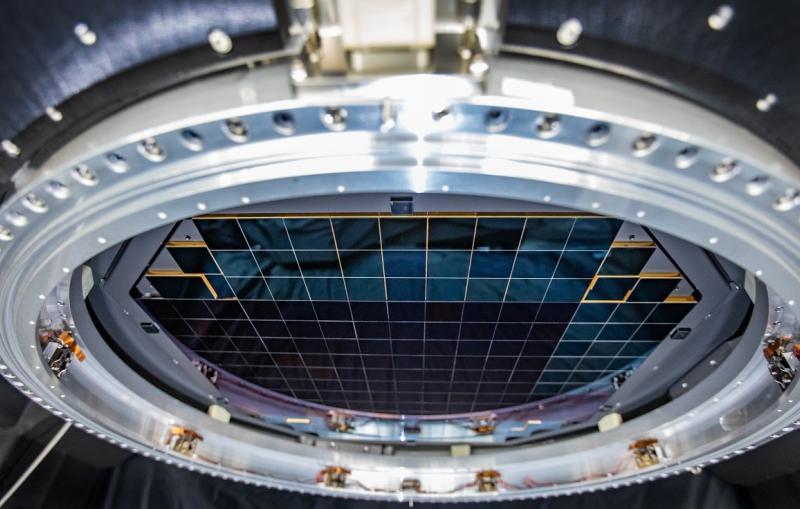
Now that NSF–DOE Vera C. Rubin Observatory’s LSST Camera has been installed, what’s next?

April 11, 2025  ·  7 min read
A large black cylindrical camera is positioned in a telescope dome.
Feature
VIA Stanford

SLAC ATLAS group among Stanford researchers receiving 2025 Breakthrough prizes

The $3 million Breakthrough Prize in Fundamental Physics went to the ATLAS, CMS, ALICE, and LHCb collaborations representing 13,508 researchers.

April 14, 2025
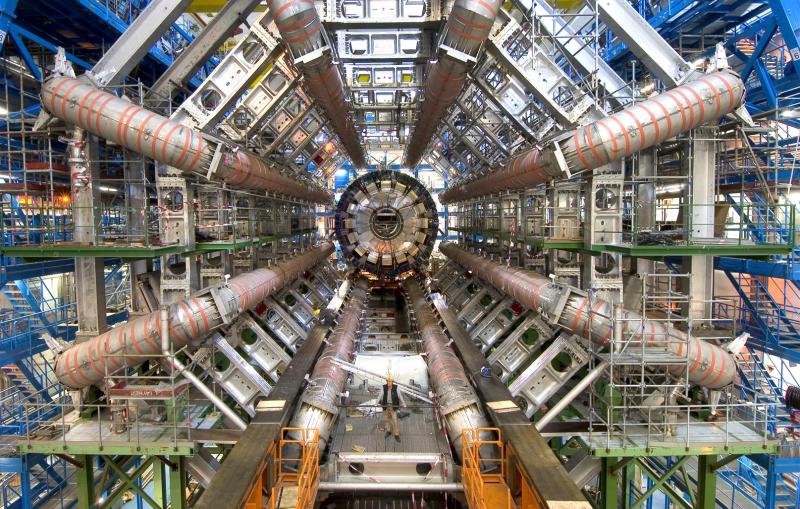
Photo of the massive mural of the ATLAS detector at CERN Point 1 painted by artist Josef Kristofoletti.
News Brief
VIA Symmetry Magazine

Explain it in 60 seconds: big data

How do you solve a problem like big data?

April 15, 2025
Illustration for big data story
Feature

Sharpening our cosmic focus

NSF–DOE Vera C. Rubin Observatory is gearing up to illuminate the Universe’s darkest secrets with groundbreaking new technology.

April 23, 2025  ·  9 min read
Cosmic Focus
News Brief
VIA Stanford

SLAC's Lance Dixon elected to the American Academy of Arts & Sciences

The theorist is one of seven Stanford faculty members elected by the Academy this year, recognizing their exceptional contributions in their fields and professions.

April 23, 2025
Lance Dixon pointing at mathematical formula on a chalkboard
News Brief
VIA Stanford

Risa Wechsler elected to National Academy of Sciences

Wechsler is one of seven Stanford researchers to join the scholarly society, which works to promote science for public good.

April 30, 2025
Risa Wechsler
Feature

Ready, Set, Process: Preparing for Rubin Observatory's Data Deluge

A look inside the data processing infrastructure built by the NSF–DOE Vera C. Rubin Observatory to handle the Universe’s greatest data challenge.

May 15, 2025  ·  8 min read
Computer code, circles and data overlaid on an image of a red-orange nebula.
Feature
VIA Rubin Observatory

NSF–DOE Vera C. Rubin Observatory Will Unlock New Understanding of Variable Stars

Rubin will observe more variable stars than ever before, enabling investigations into what drives their variation and mapping the outer limits of our galaxy.

May 14, 2025
An illustration of computers monitoring the output of a large telescope.
Feature

LSST Camera arrives at Rubin Observatory in Chile, paving the way for cosmic exploration

The largest camera ever built for astrophysics has completed the journey to Cerro Pachón in Chile, where it will soon help unlock the Universe’s...

May 22, 2024  ·  6 min read
A semi truck traveling a gravel road approaches two large telescope facilities.
Feature

Rubin Observatory and Roman Space Telescope get cosmic sneak peek from supercomputers

Researchers have released 10 terabytes of data from the OpenUniverse project, which has created a detailed simulation of the universe astrophysicists can use to...

June 12, 2024  ·  4 min read
Stars and galaxies on a black background.
Feature
VIA Symmetry Magazine

Scaling up the dark matter search

Physicists are preparing for the next generation of dark-matter experiments. 

June 18, 2024
Illustration of billiard balls on a cosmic pool table
  • Go to previous page
  • Page 1
  • …
  • Page 10
  • Page 11
  • Page 12
  • Page 13
  • Currently on page 14
  • Page 15
  • Page 16
  • Page 17
  • Page 18
  • …
  • Page 24
  • Go to next page

SLAC National Accelerator Laboratory 
2575 Sand Hill Road  
Menlo Park, CA 94025-7015  
650.926.3300

  • Coming to SLAC
  • Connect with us
  • Contact us
  • Facebook
  • Flickr
  • Instagram
  • LinkedIn
  • Twitter
  • YouTube

Sign up for our email

Monthly newsletter for cutting-edge science, SLAC milestones and events.

Sign up

Bold People
Visionary Science
Real Impact

We explore how the universe works at the biggest, smallest and fastest scales and invent powerful tools used by scientists around the globe.

  • About
    • Our story
    • Our people
    • Lab overview
    • Visit SLAC
    • Resources
    • Connect with us
  • Research
    • X-ray & ultrafast science
    • Advanced accelerators
    • New technologies
    • Physics of the universe
    • Science of life
    • Energy sciences
    • SLAC science explained
  • Facilities & centers
    • Scientific facilities
    • Joint institutes & centers
  • Work with us
    • Partner with us
    • Become a supplier
    • Use our facilities
    • Careers at SLAC
  • News & events
    • News center
    • Symmetry Magazine
    • Media resources
    • Events
    • Educational programs
    • Connect with us
  • Staff portal
  • Privacy policy
  • Accessibility
  • Vulnerability disclosure
  • A–Z index
  • Website feedback
Home
  • SLAC home
  • Maps & directions
  • Emergency info
  • Careers

© 2026 SLAC National Accelerator Laboratory is operated by Stanford University for the U.S. Department of Energy Office of Science.

Stanford University U.S. Department of Energy
Top Top
Back to top Back to top