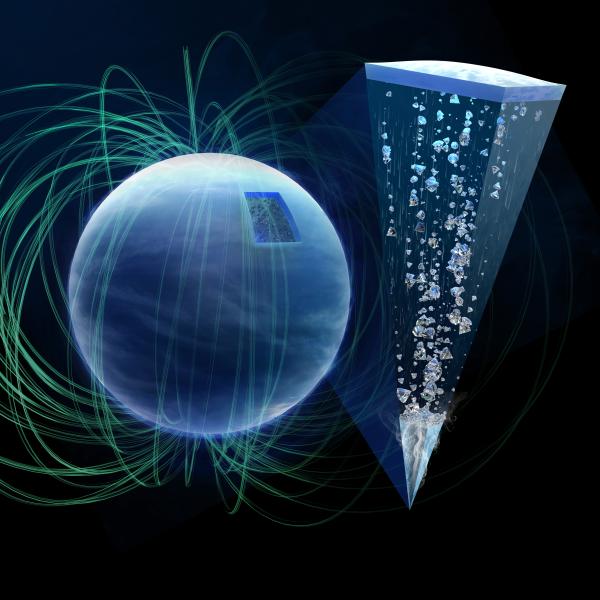
The team unexpectedly formed gold hydride in an experiment that could pave the way for studying materials under extreme conditions like those found inside certain planets and stars undergoing nuclear fusion.
The technique could improve how scientists study materials and drive advancements in high-performance technologies, such as next-generation computer chips.
SLAC Deputy Director for Science and Technology Alberto Salleo's lab at Stanford is creating artificial synapses to replicate the brain’s efficiency and learning capacity in computing systems.
His visit highlighted the breadth of our world-class research and the people and collaborations that make it possible. A key theme of the day: how SLAC and the National Labs are advancing AI to accelerate discovery.
The research could lead to a better understanding of extreme astrophysical environments and the development of compact high-energy radiation sources for science.
The process, which also facilitates name changes for religious, marital and other reasons, allows researchers of all genders to own their academic work by updating their names on previous publications.
Fulfilling a prediction of Einstein’s theory of General Relativity, researchers report the first-ever recordings of X-ray emissions from the far side of a black hole.
Belopolski has made key discoveries about Weyl semimetals and topological magnets, systems in which quantum effects produce new emergent particles with exotic electronic and magnetic properties.
Their work aims to bridge two approaches to driving the reaction – one powered by heat, the other by electricity – with the goal of discovering more efficient and sustainable ways to convert carbon dioxide into useful products.