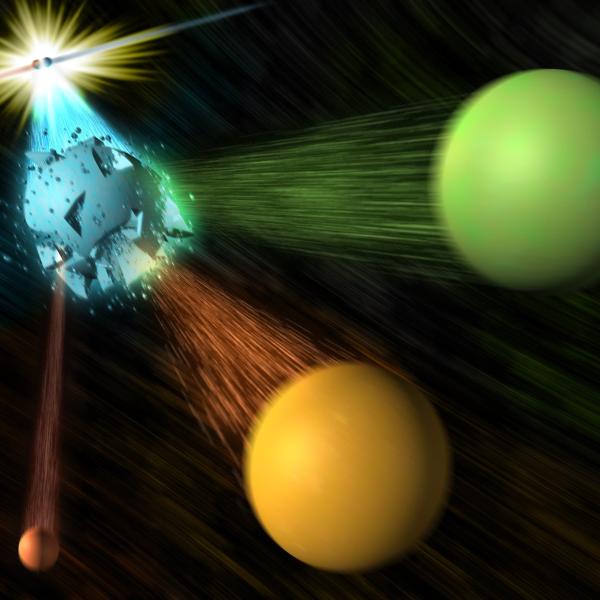
A new study confirms what scientists have long suspected: Cosmic rays – energetic particles that pelt Earth from all directions – are born in the violent aftermath of supernovas, exploding stars throughout the galaxy.
Scientists at Stanford and SLAC have found a potential way to harness the amazing properties of topological insulators – materials that conduct electricity only along their surfaces – for use in electronics and other applications.
Many advanced laser technologies, such as laser spectroscopy, that use precise wavelengths of infrared, visible or ultraviolet laser light could benefit from using X-ray light as well.
Stanford University's Precourt Institute for Energy (PIE), TomKat Center for Sustainable Energy and Precourt Energy Efficiency Center (PEEC) have awarded nine faculty seed grants totaling $2.2 million for promising new research in clean technology and energy efficiency.
A team of Stanford University researchers used the Stanford Synchrotron Radiation Lightsource to gain a deeper understanding of a vital family of signaling proteins responsible for regulating an organism’s development and growth, as well as tissue regeneration and wound healing.
Menlo Park, Calif. – Scientists have used powerful X-rays from the Linac Coherent Light Source (LCLS) at the U.S. Department of Energy's (DOE) SLAC National Accelerator Laboratory to study and measure, in atomic detail, a key process at work in...
When it comes to improving the performance of lithium-ion batteries, no part should be overlooked – not even the glue that binds materials together in the cathode, researchers at SLAC and Stanford have found.
Richard "Dick" Barr Neal, a key figure in the design, construction and operation of SLAC's 2-mile-long linear accelerator, died Nov. 22, 2012 in Solana Beach, Calif., at age 95.
Blue-glowing diamond crystals hold promise for expanding the research capacity of SLAC's X-ray laser by divvying up its pulses for use in separate, simultaneous experiments.
A high-energy SLAC laser that creates shock waves and superhot plasmas needs to cool for about 10 minutes between shots. In the meantime, the rapid-fire pulses produced by SLAC's Linac Coherent Light Source X-ray laser, which probes the extreme states...
Jonathan Rivnay, a Stanford graduate student in materials science who has conducted significant research at the Stanford Synchrotron Radiation Lightsource on the relationships between the structure and electrical properties of organic semiconductors, has been selected to receive the 2011 Melvin...