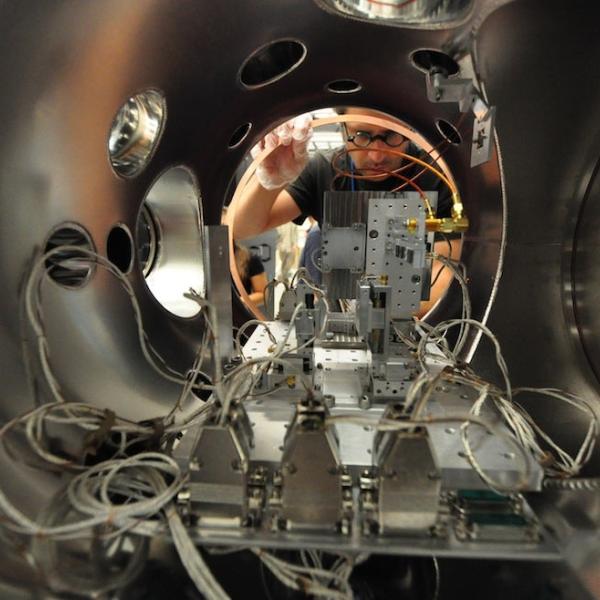
As they say in the movie business, here's the pitch: tantalizing hints of an interaction that could demonstrate the existence of a new subatomic particle have emerged during the last months of operation of a venerable particle accelerator (the Tevatron...
Using laser light to read and write magnetic data by quickly flipping tiny magnetic domains could help keep pace with the demand for faster computing devices.
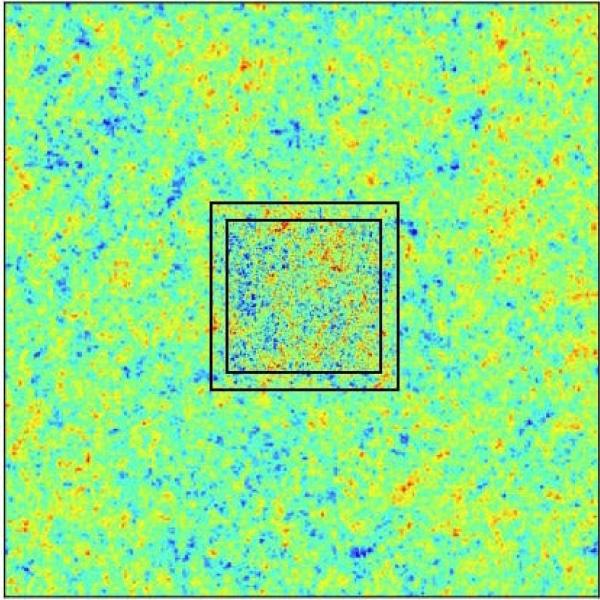
Computer simulations have become an invaluable tool to study the formation of cosmic structures over an enormous range of scales, crucial aspects of the evolution of the Universe which cannot be directly observed
Three theoretical physicists have taken an important step toward eliminating theoretical ambiguities from the staggeringly complicated mathematics used to explore the interactions of quarks, the tiniest known bits of matter inside protons and neutrons, and gluons, the enigmatic particles responsible...
Stanford University announced today that Persis S. Drell, director at SLAC National Accelerator Laboratory, has decided to return to her position as a faculty member.
Britain’s Royal Astronomical Society has named Stanford University Physics Professor Roger Blandford as the 2013 winner of the Society’s highest honor, the Gold Medal.
Tiny particles are making a big difference in the world of cancer therapy. And SLAC physicists—experts in particle transport—are using computer simulations to make those therapies safer.
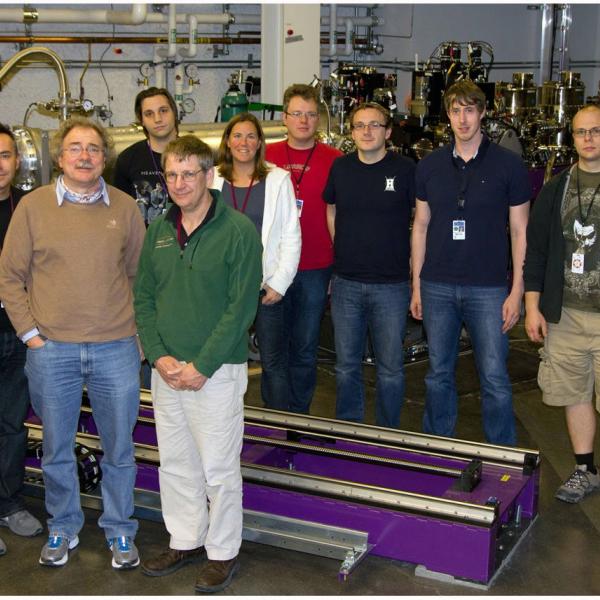
After five night shifts of shooting pairs of X-ray pulses through soups of fine sand and gold, Aymeric Robert was tired but exhilarated. The first experiment with an instrument he helped bring into being – the X-ray Correlation Spectroscopy (XCS)...
Accelerator technology has made huge leaps forward, prompting important developments well beyond high energy physics in areas as diverse as energy and the environment, medicine, industry, national security and discovery science.