Accelerator physicists at SLAC and cancer specialists from Stanford are working on a new technology that could dramatically reduce the time needed for cancer radiation treatments.
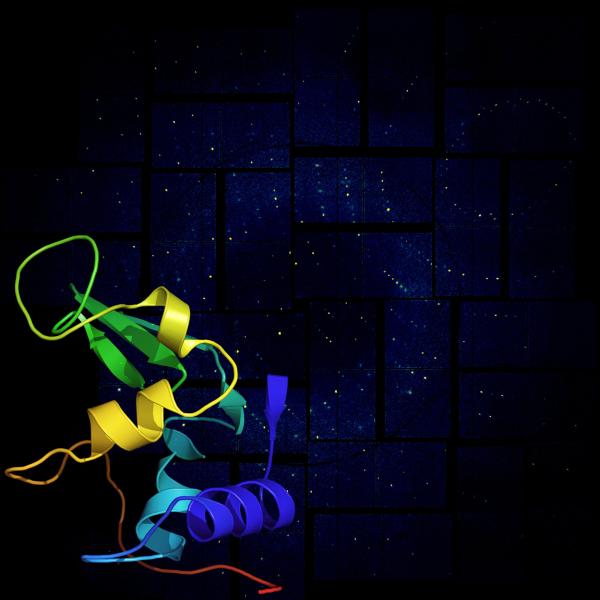
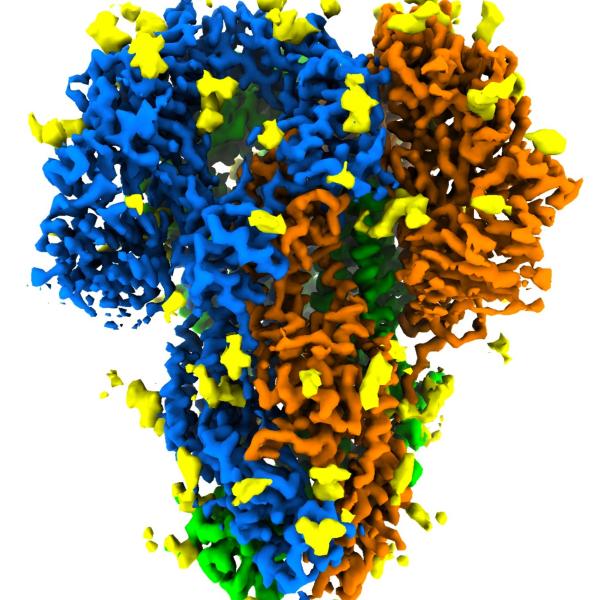
A small team of researchers has used the brilliant X-rays of the Stanford Synchrotron Radiation Laboratory to pin down the crystalline structure of an enzyme complex that scientists had spent nearly a decade trying to resolve.
In celebration of Women’s History Month, the Department of Energy recently launched a new feature, Women @ Energy, which showcases DOE employees who work in the fields of science, technology, engineering and mathematics (STEM).
Menlo Park, Calif. — If we could make plant food from nitrogen the way nature does, we’d have a much greener method for manufacturing fertilizer – a process that requires such high temperatures and pressures that it consumes about 1.5...
While SLAC's Linac Coherent Light Source was designed to push the limits as a high-energy X-ray laser, users' requests have led staff at the facility to successfully step it back to a lower minimum energy for some experiments.
In a two-day event commemorating the 50th anniversary of SLAC National Accelerator Laboratory, about 1,000 employees, former employees and university, government and scientific leaders celebrated the lab's successes and looked ahead to the next great challenges.
Menlo Park, Calif. — Opening a new window on the way plants generate the oxygen we breathe, researchers used an X-ray laser at the Department of Energy’s (DOE) SLAC National Accelerator Laboratory to simultaneously look at the structure and chemical...
Astronomers using data from NASA's Fermi Gamma-ray Space Telescope have made the most accurate measurement of starlight in the universe and used it to establish the total number of stars that have ever shone, accomplishing a primary mission goal.
It sounds like something out of a cheesy science fiction movie, but thanks to new research led by Yi Cui, a professor of photon science at SLAC, transparent cell phones are one step closer to becoming a reality.
Jens Nørskov, director of SLAC's SUNCAT Center for Interface Science and Catalysis, has received the G.A. Hagemann Gold Medal for engineering scientific research from the Technical University of Denmark (DTU).