When it comes to improving the performance of lithium-ion batteries, no part should be overlooked – not even the glue that binds materials together in the cathode, researchers at SLAC and Stanford have found.
Richard "Dick" Barr Neal, a key figure in the design, construction and operation of SLAC's 2-mile-long linear accelerator, died Nov. 22, 2012 in Solana Beach, Calif., at age 95.
Blue-glowing diamond crystals hold promise for expanding the research capacity of SLAC's X-ray laser by divvying up its pulses for use in separate, simultaneous experiments.
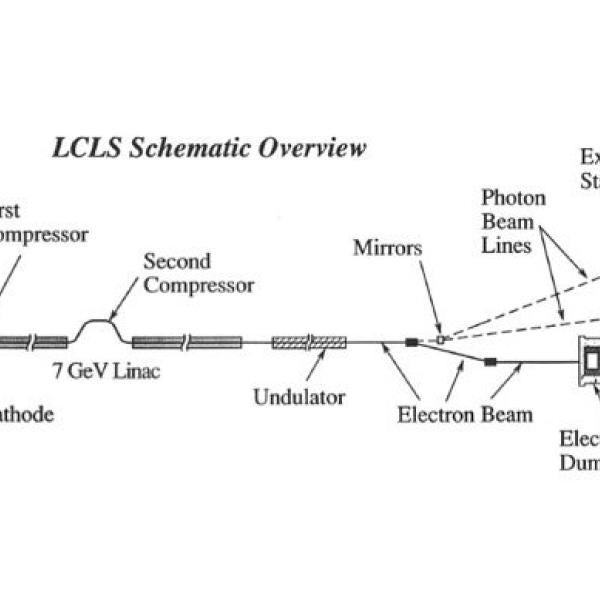
A high-energy SLAC laser that creates shock waves and superhot plasmas needs to cool for about 10 minutes between shots. In the meantime, the rapid-fire pulses produced by SLAC's Linac Coherent Light Source X-ray laser, which probes the extreme states...
Jonathan Rivnay, a Stanford graduate student in materials science who has conducted significant research at the Stanford Synchrotron Radiation Lightsource on the relationships between the structure and electrical properties of organic semiconductors, has been selected to receive the 2011 Melvin...
The latest report on SESAME, a synchrotron light source that will be the first big international science center in the Middle East, says it is progressing both technically and financially on the road to its scheduled opening in 2015.
One way to make magnetic storage drives faster would be to use light to flip the polarity of tiny patches of material, called magnetic domains, back and forth – from 0 to 1 and back again, in computing terms.
The search for dark matter runs deep with physicists Blas Cabrera and Bernard Sadoulet, who have chased this mystery far underground and will be recognized for their work as joint recipients of the 2013 W.K.H. Panofsky Prize in Experimental Particle...
Theoretical physicist and SLAC Professor Emeritus Helen Quinn chaired a National Academy of Sciences committee that last week issued A Framework for K-12 Science Education, which “identifies the key scientific practices, concepts and ideas that all students should learn by...
On June 11, 2008, what was then the Gamma-ray Large Area Space Telescope rode a Delta II rocket into low-Earth orbit. After two months of tests and checks and calibrations, on August 11, 2008, NASA declared GLAST open for business...
A big reason for publishing scientific results is to inform others who can then use your data and conclusions to make additional discoveries, technologies or products.