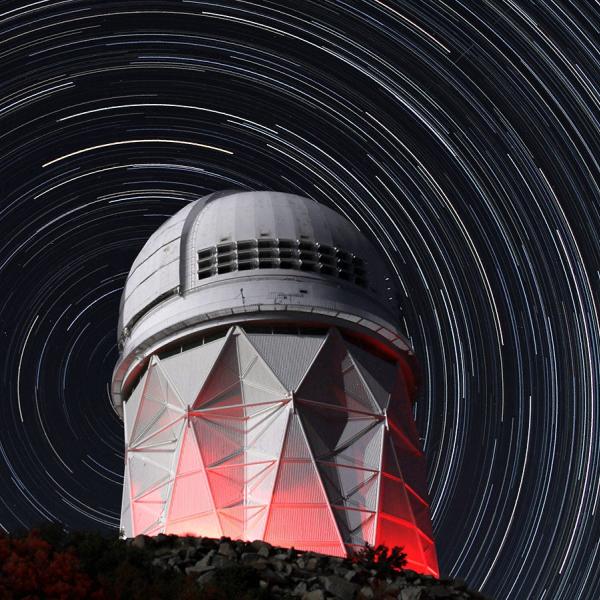
A detailed picture of the seeds of structures in the universe has been unveiled by an international team co-led by Sarah Church of the Kavli Institute for Particle Astrophysics and Cosmology, jointly located at the Department of Energy’s SLAC National...
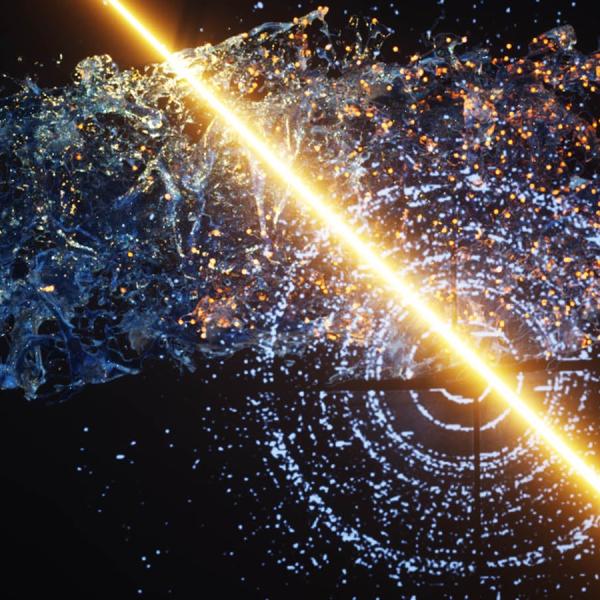
Water is familiar to everyone—it shapes our bodies and our planet. But despite this abundance, the molecular structure of water has remained a mystery, with the substance exhibiting many strange properties that are still poorly understood.
The first black holes in the universe had dramatic effects on their surroundings despite the fact that they were small and grew very slowly, according to recent supercomputer simulations carried out by astrophysicists Marcelo Alvarez and Tom Abel of the...
The Department of Energy's SLAC National Accelerator Laboratory will receive $21.8 million in new funding from the American Recovery and Reinvestment Act.
The earliest stars in the universe formed not only as individuals, but sometimes also as twins, according to a paper published today in Science Express.
SLAC National Accelerator Laboratory is home to a two-mile linear accelerator—the longest in the world. Originally a particle physics research center, SLAC is now a multipurpose laboratory for astrophysics, photon science, accelerator and particle physics research.
With the greatest total energy, the fastest motions, and the highest-energy initial emissions ever before seen, a gamma-ray burst recently observed by the Fermi Gamma-ray Space Telescope is one for the record books.
Physicists have set a new world record for the smallest writing, with features of letters as small as 0.3 nanometers, or roughly one third of a billionth of a meter.
A keystone of evolutionary history, the Thermopolis Archaeopteryx fossil, has come to the U.S. Department of Energy's (DOE) SLAC National Accelerator Laboratory to undergo a revolutionary type of analysis.
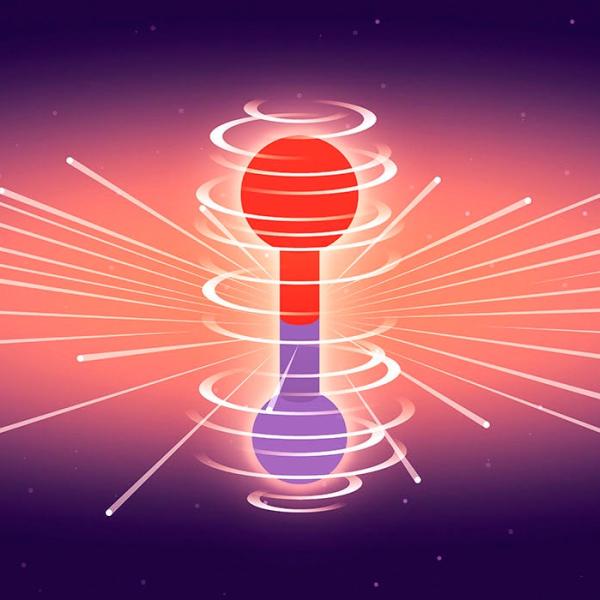
About three times a second, a 10,000-year-old stellar corpse sweeps a beam of gamma-rays toward Earth. This object, known as a pulsar, is the first one known to "blink" only in gamma rays, and was discovered by the Large Area...