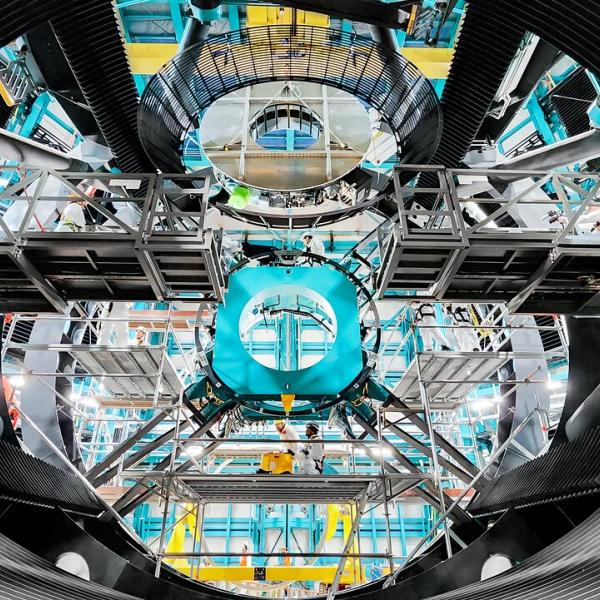
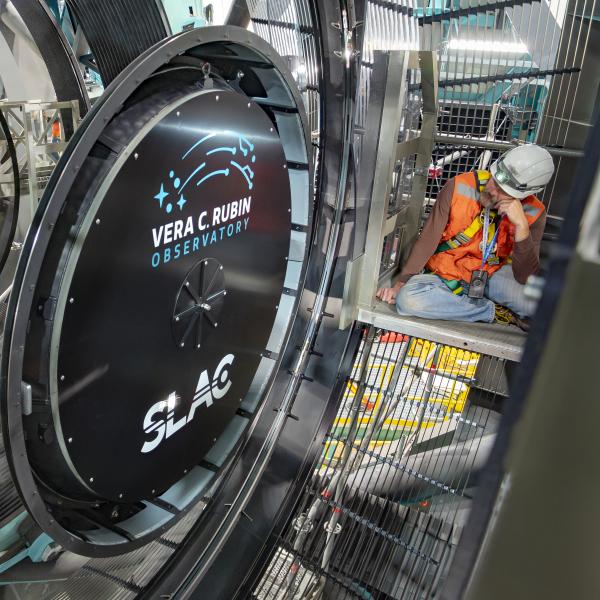
The 3.5-meter glass mirror is the first permanent component of the Simonyi Survey Telescope's state-of-the-art, wide-field optical system to be installed and will soon contribute to a better understanding of our Universe.
LSST is currently under construction in Chile. The U.S. Department of Energy’s SLAC National Accelerator Laboratory is leading the construction of the LSST camera – the largest digital camera ever built for astronomy.
Toro and Schuster are being recognized for their contributions to the design of experiments that use particle accelerators to search for dark matter particles.
SLAC researchers contributed to the design, construction, testing and analysis of the experiment, which has already put the tightest bounds yet on a popular theory of dark matter.
They’ll work on experiments that search for dark matter particles and exotic neutrino decays that could help explain why there’s more matter than antimatter in the universe.
To capture as much information as possible about clouds of atoms at the heart of the MAGIS-100 experiment, SLAC scientists devised a dome of mirrors that gathers more light from more angles.
A cosmologist, cultural historian, and neurosurgeon discuss how outer space and otherworldly phenomena can inspire discovery across disciplines and bring people together.