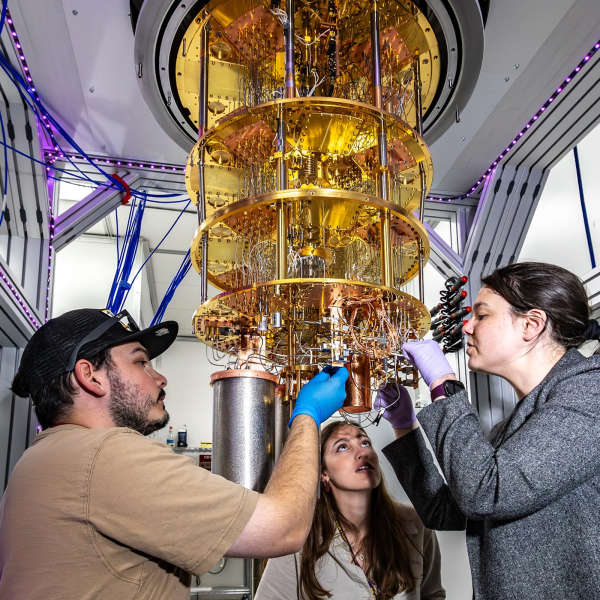
Driven by curiosity about nature, SLAC researcher Shannon Harvey develops quantum dots, a mass-producible type of qubit, as part of the Q-NEXT collaboration.
This event is free, open to all, and family-friendly hosted by Kavli Institute for Particle Astrophysics and Cosmology (KIPAC) at Stanford University, Science & Engineering Quad.
A new program led by SLAC and Sandia national laboratories connects investors and entrepreneurs with Department of Energy scientists to launch startups in key technology areas.
The deep-underground experiment could produce early-scientific results in the search for one of nature’s most elusive substances even, before reaching optimal sensitivity when the full search begins next year.
Machine Learning (ML) algorithms are found across all scientific directorates at SLAC, with applications to a wide range of tasks including online data reduction, system controls, simulation and analysis of big data.
The LUX-ZEPLIN experiment observed a particle interaction that could be interpreted as a signal from WIMPs, a dark matter candidate – but researchers will need more data to confirm.