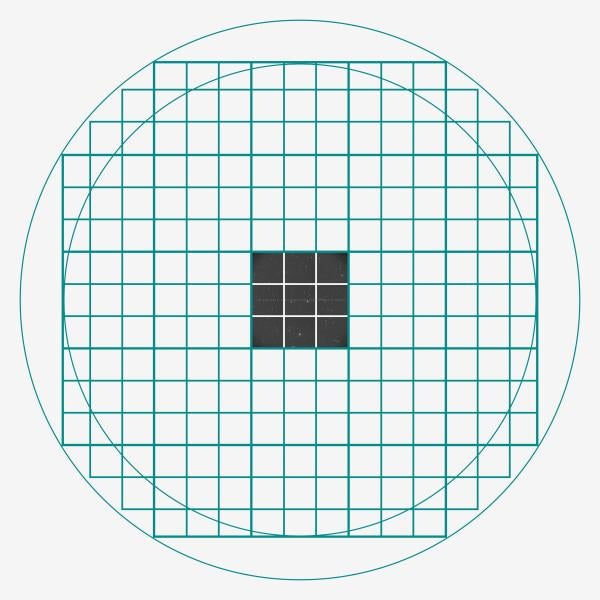
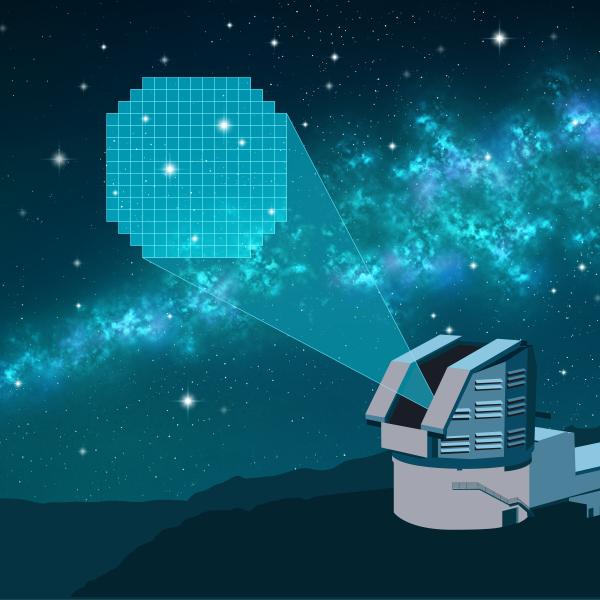
SLAC Recent History (1990s-today NSF-DOE Vera C. Rubin Observatory LSST Camera module) – Building the largest digital camera for a 10-year survey of the universe in search of dark matter and a detailed mapping of our solar system, such as...
In its infancy, the universe was awash in fundamental particles. Over billions of years, matter cooled and clumped into stars and galaxies, tied together by a cosmic web of dark matter.
To explore the birth of the universe, the formation of stars and galaxies and the fundamental structure of space and time, SLAC researchers develop cutting-edge technologies for sensitive experiments located deep underground, on the surface and in space.
Accelerators form the backbone of SLAC's national user facilities. They are complicated machines, with hundreds of thousands of components that all need to be designed, engineered, operated and maintained to achieve the highest energy acceleration and the highest quality particle...
Working at the forefront of particle physics, SLAC scientists use powerful particle accelerators to create and study nature’s fundamental building blocks and forces, build sensitive detectors to search for new particles and develop theories that explain and guide experiments.
This image captures a small section of NSF–DOE Vera C. Rubin Observatory’s view of the Virgo Cluster, offering a vivid glimpse of the variety in the cosmos.
From left, SCU Physics Prof. Betty Young, Software Developer Concetta "Tina" Cartaro and Senior Staff Scientist Richard Partridge put the fourth, and final, SuperCDMS tower safely back into its storage container.
In the largest dataset ever collected by a dark matter detector, LUX-ZEPLIN's latest results provide the strongest constraints on low-mass WIMPs and detect boron-8 solar neutrinos.
Vera C. Rubin Observatory will conduct the 10-year Legacy Survey of Space and Time (LSST), which will collect 60 petabytes of data to address some of the most pressing questions about the structure and evolution of the universe and the...