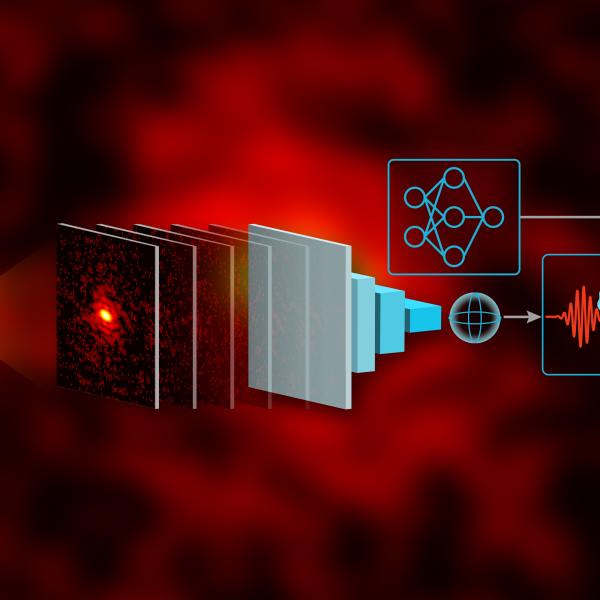
The SLAC team is developing digital twins – powered by AI and high-performance computing – to help quickly shape high-quality particle beams for the lab’s X-ray and ultrafast facilities.
An upgrade to SLAC’s renowned Linac Coherent Light Source will allow it to deliver X-ray laser beams that are 10,000 times brighter with pulses that arrive up to a million times per second.
Experiments running at these higher pulse rates will allow scientists to capture ultrafast processes with greater precision, collect data more efficiently and explore phenomena that were previously out of reach.
Researchers taking the first-ever direct measurement of atom temperature in extremely hot materials inadvertently disproved a decades-old theory and upended our understanding of superheating.
SLUO represents scientists and engineers from universities and laboratories around the world involved in particle physics, astrophysics and accelerator physics research at SLAC.