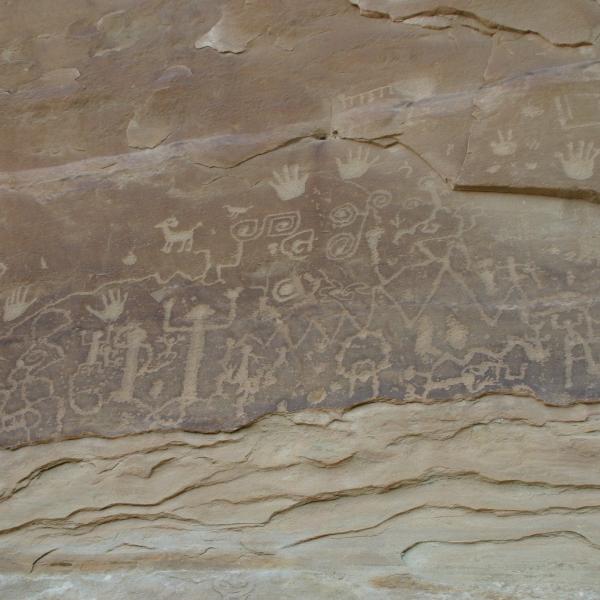
Petroglyphs are carved in a material called rock varnish, the origins of which have been debated for years. Now, scientists argue it’s the result of bacteria and an adaptation that protects them from the desert sun’s harsh rays.
Presented by Aaron Lindenberg. As we reach the limits of high-speed computation based on silicon, ideas for the next generation of computers have focused on electrically switchable nanoscale devices that operate in ways similar to the neurons and synapses of...
Q-NEXT will tackle next-generation quantum science challenges through a public-private partnership, ensuring U.S. leadership in an economically crucial arena.
Daniel Ratner, head of SLAC’s machine learning initiative, explains the lab’s unique opportunities to advance scientific discovery through machine learning.
Presented by Diana Gamzina. In particle accelerators, electrons are pushed to extreme energies by electromagnetic fields that oscillate inside evacuated metal cavities. Those cavities are usually made of copper.
The lab’s X-ray laser recently joined other facilities in making remote science possible from any corner of the world, a trend that will likely continue into the future.
The newly launched Quantum Fundamentals, ARchitecture and Machines initiative will build upon existing strengths in theoretical and experimental quantum science and engineering at Stanford and SLAC.
Monika Schleier-Smith and Kent Irwin explain how their projects in quantum information science could help us better understand black holes and dark matter.
Particle accelerators are used every day in a wide range of scientific, medical and industrial applications. But did you know that the task of operating these machines is far from mundane? For example, for every experiment at SLAC’s X-ray laser...