The method could lead to the development of new materials with tailored properties, with potential applications in fields such as climate change, quantum computing and drug design.
Scientists demonstrated a materials characterization technique can be successful at a new type of facility, and they used it at LCLS to discover a hidden materials phase.
Discovering millions of galaxies and unraveling the mysteries of dark matter and dark energy is far out! Join us at the Dutch Goose for SLAC on Tap on August 22 at 5 pm, when SLAC engineer Hannah Pollek will talk...
Their method provides a new tool to study electron-electron interactions, which are fundamental to many technologies, including semiconductors and solar cells.
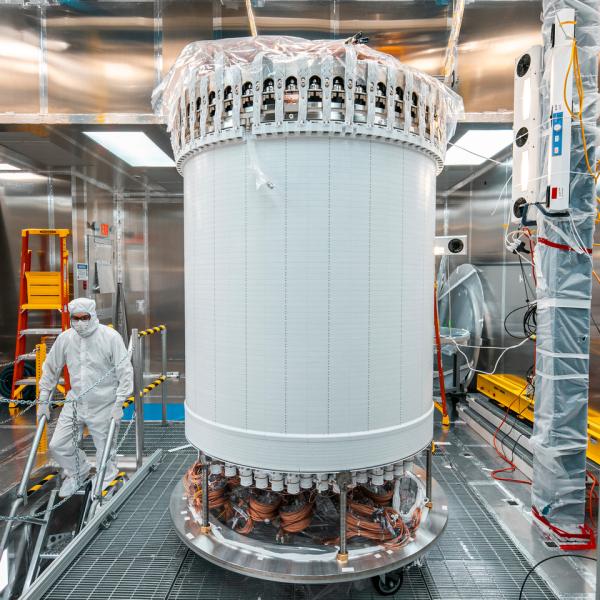
New results from the world’s most sensitive dark matter detector put the best-ever limits on particles called WIMPs, a leading candidate for what makes up our universe’s invisible mass.