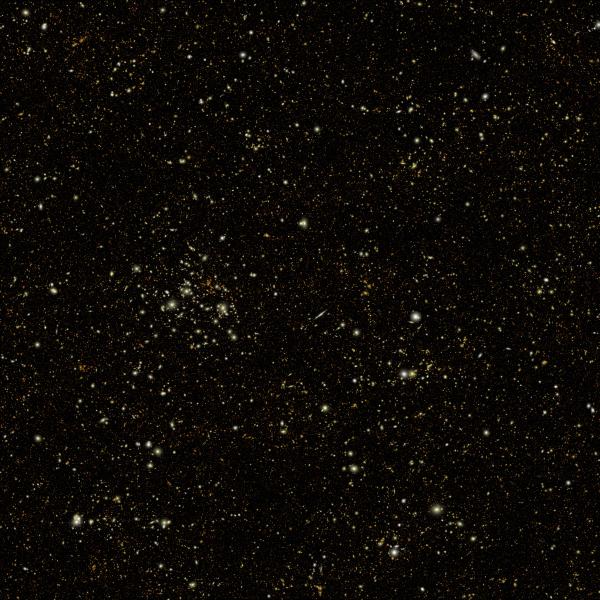
The Dark Energy Spectroscopic Instrument begins final testing, setting the stage for a 5-year survey that will analyze the light of 35 million galaxies.
Presented by Eric Charles. A single gamma ray carries millions of times the energy of a single photon of visible light. This means that gamma rays are produced only in the most convulsive environments in the universe – pulsars spinning...
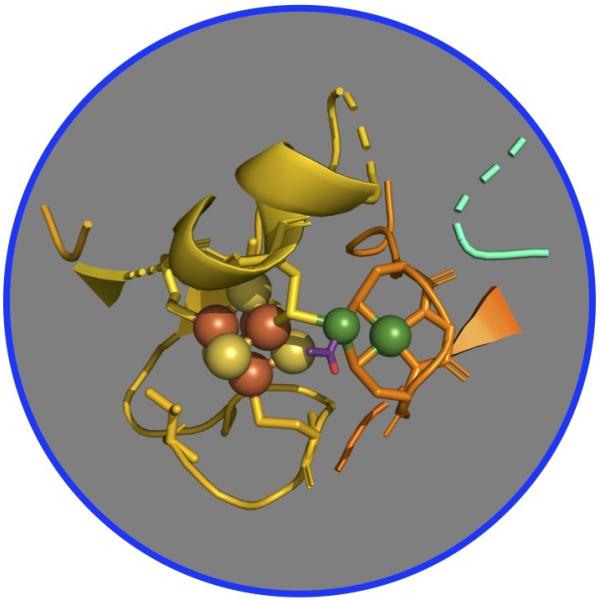
Researchers discover that a spot of molecular glue and a timely twist help a bacterial enzyme convert carbon dioxide into carbon compounds 20 times faster than plant enzymes do during photosynthesis. The results stand to accelerate progress toward converting carbon...
Toro and Schuster are being recognized for their contributions to the design of experiments that use particle accelerators to search for dark matter particles.
After almost two decades of synchrotron experiments, Caltech scientists have captured a clear picture of a cell’s nuclear pores, which are the doors and windows through which critical material in your body flows in and out of the cell’s nucleus...
SLAC researchers contributed to the design, construction, testing and analysis of the experiment, which has already put the tightest bounds yet on a popular theory of dark matter.
They’ll work on experiments that search for dark matter particles and exotic neutrino decays that could help explain why there’s more matter than antimatter in the universe.
An extension of the Stanford Research Computing Facility will host several data centers to handle the unprecedented data streams that will be produced by a new generation of scientific projects.
To capture as much information as possible about clouds of atoms at the heart of the MAGIS-100 experiment, SLAC scientists devised a dome of mirrors that gathers more light from more angles.
En route to record-breaking X-rays, SLAC’s Cryogenic team built a helium-refrigeration plant that lowers the LCLS-II accelerator to superconducting temperatures.