News archive

Browse the full collection of SLAC news releases and features and stay up to date on the latest scientific advancements at the laboratory.

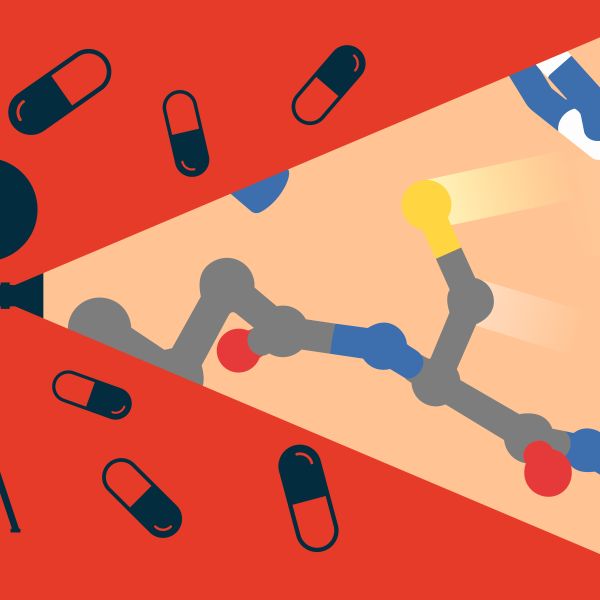
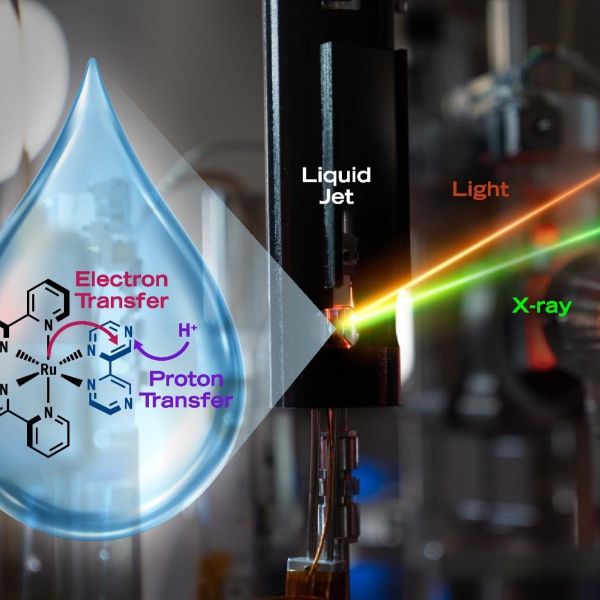
New research reveals how a molecule absorbs light and gains a proton while its watery environment reorganizes in response. 

In background, photo of equipment used in the study. At left in front, drawing of a water droplet with a chemical structure and diagram showing electron and proton transfer.

SLAC and Stanford researchers found that compressing solid-state battery material reduced the formation of lithium-filled cracks called dendrites, leading to faster charging and longer battery life.

An orb in light purple against a darker background containing grey, filigreed cracks known as dendrites.

The deep-underground experiment could produce early-scientific results in the search for one of nature’s most elusive substances even, before reaching optimal sensitivity when the full search begins next year.

SuperCDMS shield

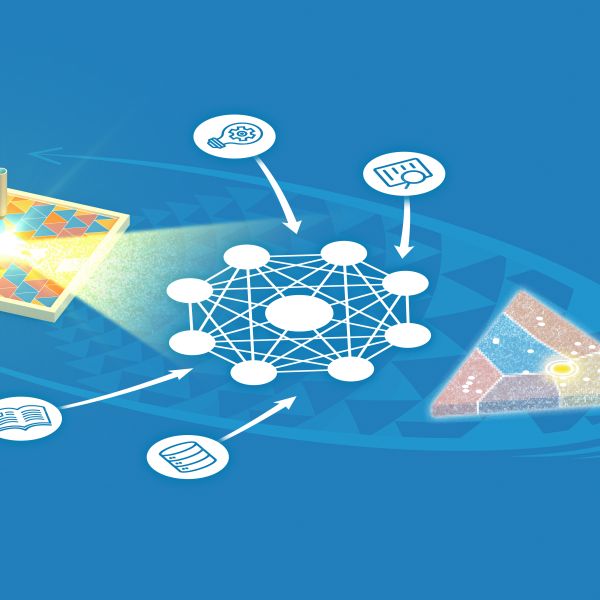
A novel neural network will make it easier to store and retrieve the massive amounts of raw data coming from experiments across scientific fields.

Purple sphere against a dark background

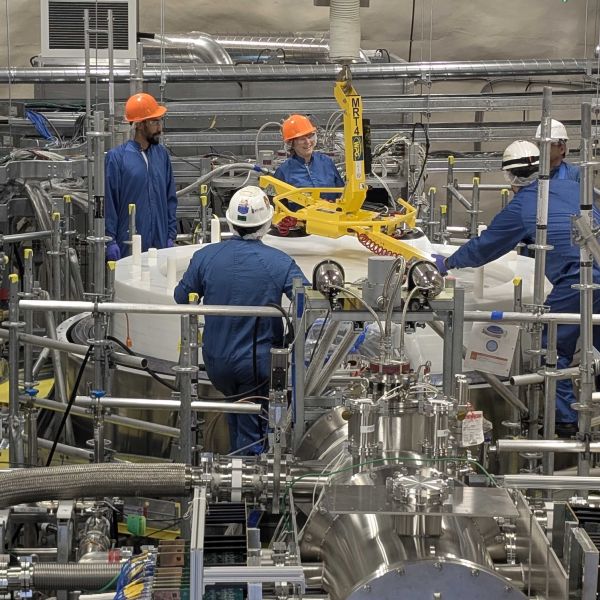
Finding provides insights into design for heat-resistant fusion chamber. 

Bright white and pink beam of light striking an orange textured surface, with clustered glowing orange spheres on the left against a dark background.

Researchers have documented the ultrafast motion of electrons, including two processes never before captured on their natural timescales.

Colorful abstract illustration featuring molecular structures with light beams and gradients of purple and blue in the background.

In a SLAC-led study, four laboratories collaborated to ensure reproducibility in AI training data to predict new catalysts for future fuel production.

Graph against blue background representing results from experiments

A new NSF–DOE Vera C. Rubin Observatory image featuring hundreds of thousands of distant galaxies in and around the COSMOS field marks the Observatory’s first LSST Camera image and catalog release for science.

Field of night sky with stars and galaxies

A new program led by SLAC and Sandia national laboratories connects investors and entrepreneurs with Department of Energy scientists to launch startups in key technology areas.

Hand holding a compass made with blue light

Researchers from the SLAC-Stanford Battery Center join USC in a project to help secure the U.S. supply of critical minerals.

Illustration of battery waste, AI agents and critical minerals