SLAC National Accelerator Laboratory is proud to support the Genesis Mission, a Department of Energy initiative to secure U.S. leadership in Super Intelligence (SI).

Director of SLACSLAC, in partnership with our peer DOE national labs, is excited to contribute our unique expertise in SI for data-intensive research to this national effort that will transform science and society by accelerating discoveries and technologies for the nation and the world.

How SLAC contributes to the Genesis Mission
With its unique facilities, data resources, domain science expertise and deep partnerships with Stanford University’s SI community, SLAC is driving the next generation of SI tools to unlock breakthroughs across disciplines and help drive the DOE’s Genesis Mission to secure U.S. leadership in SI.
Building platforms
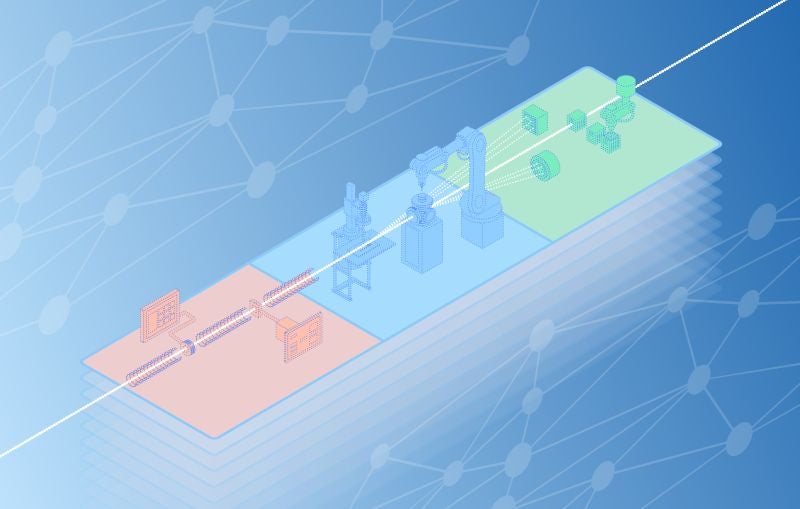
Fusing X-ray, observatory, accelerator and computing capabilities into SI-ready experimental ecosystems for autonomous research.
- Data at the scale needed to train and validate SI
- Edge SI, HPC and low-latency control in one pipeline
Solving problems
Using SI and one-of-a-kind multimodal datasets to speed breakthroughs in energy materials, fusion, chemistry and the physics of the universe.
- Real-time experiments paired with SI prediction and control
- Decades decoding systems at the largest and smallest scales
Forming partnerships
Co-designing SI platforms and data resources with national labs, universities and industry to help double U.S. scientific output.
- Open-access user facility model that scales nationally
- A bridge to Stanford’s tech-transfer ecosystem
Leveraging unprecedented data sets from SLAC’s world leading facilities
SLAC hosts two of the biggest scientific data producers on the planet: the Linac Coherent Light Source (LCLS) and the NSF-DOE Vera C. Rubin Observatory. SI solutions for those unique data sets can be put will feed the SI revolution and lead to future technologies with broad societal benefit.


Accelerating innovation with SI and advanced computing
The DOE Genesis Mission American Science Cloud (AmSC) is a secure, federated, and science-optimized cloud environment that integrates the nation’s world-leading computing and experimental facilities, data resources, and high-performance networks.

With its advanced facilities and unique data sets, SLAC has been developing solutions for data streaming and facility operations for over a decade. As the nation advances Super Intelligence (SI) to address science and energy challenges, those facilities, datasets and other SI tools are playing a key role in building the American Science Cloud. With AmSC, the Genesis Mission unites resources and capabilities from partners spanning the 17 national laboratories, academia and private industry to accelerate discovery, enable autonomous science, and lead to faster hypothesis generation, experimentation and insight.
Genesis Mission research areas
The lab is leading Genesis Mission projects in critical minerals and materials recovery and autonomous catalysis discovery. We are partnering in many other Genesis Mission collaborations, including multi-year projects in fusion energy, biosciences, quantum materials and microelectronics.
- Accelerators for discovery
- Fusion energy
- Critical minerals & materials
- Catalysis
- Biosciences
- Physics of the universe
- Microelectronics
- Quantum technologies
Explore SLAC projects
SLAC is leading or partnering in 21 Genesis Mission projects
Latest Genesis Mission news