November 19, 2012

Magnetism Combines with Gravity to Shape Black Hole's Environment

Black holes are the ultimate Bogeyman.

By Lori Ann White

Black holes are the ultimate Bogeyman. With a well-deserved reputation as monstrous destructive machines, black holes owe their power to huge quantities of mass that warp space and time until the gravitational force they command sucks in everything – even light. No surprise that astrophysicists have long considered gravity the dominant player in shaping the accretion disks of dust and gas surrounding black holes.

But that may not be true, at least for spinning black holes. In a paper published today in Science Express, three astrophysicists focus on a different fundamental force: magnetism. In state-of-the-art simulations that follow both the rules of general relativity and the laws of magnetism, they demonstrate that gravity isn’t the sole arbiter of a spinning black hole’s behavior.

“We found that the black hole’s magnetic field interacting with its gravity and spin has an even bigger effect” than gravity alone, said first author Jonathan McKinney, who, before he became an assistant professor of physics at the University of Maryland, was a postdoctoral researcher at Stanford University and SLAC National Accelerator Laboratory, where he did much of the work for the paper.

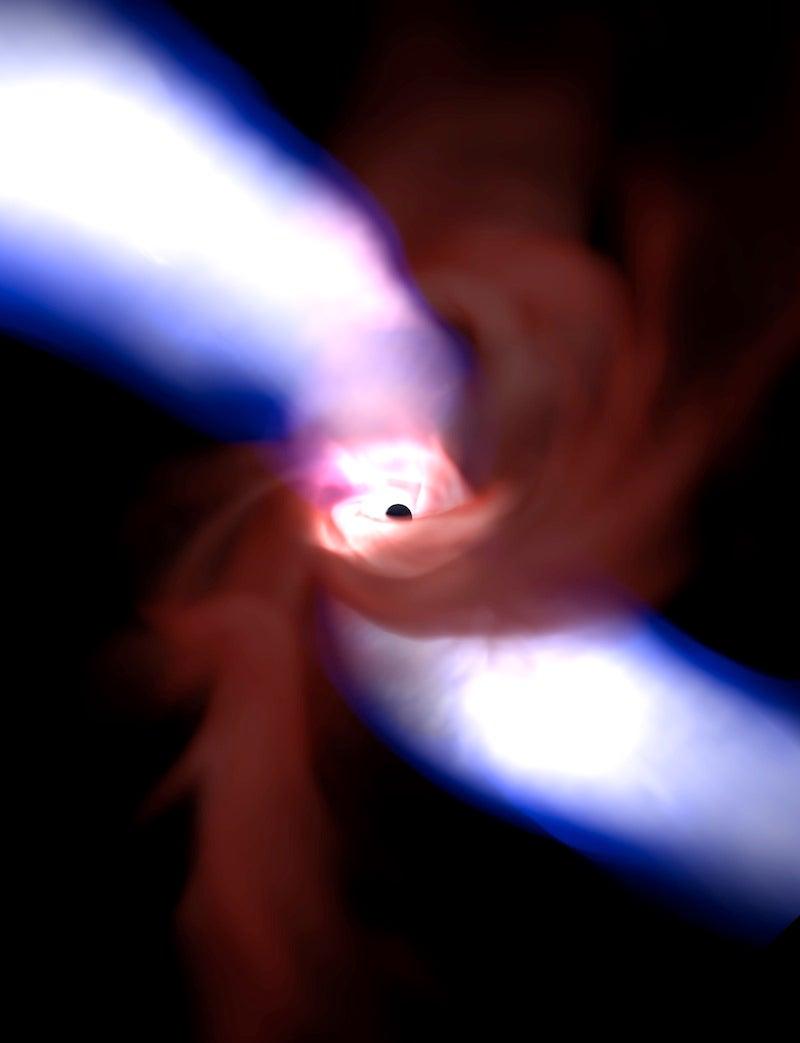
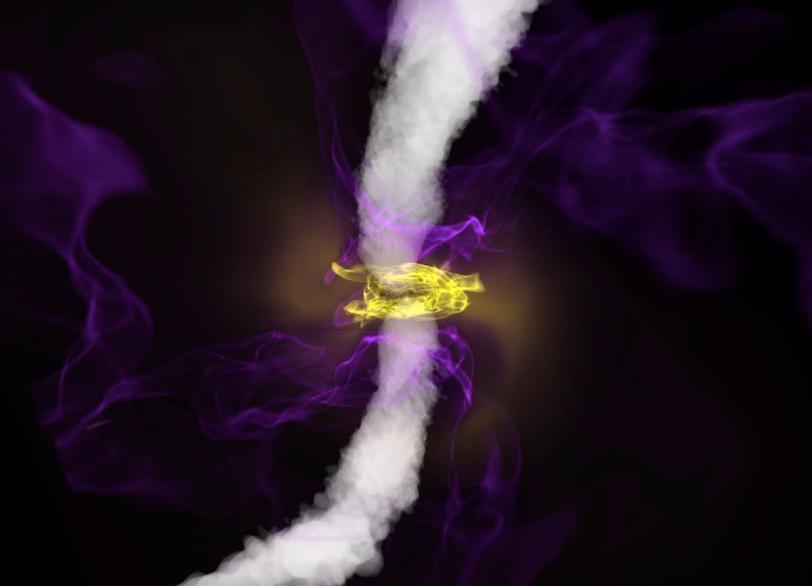
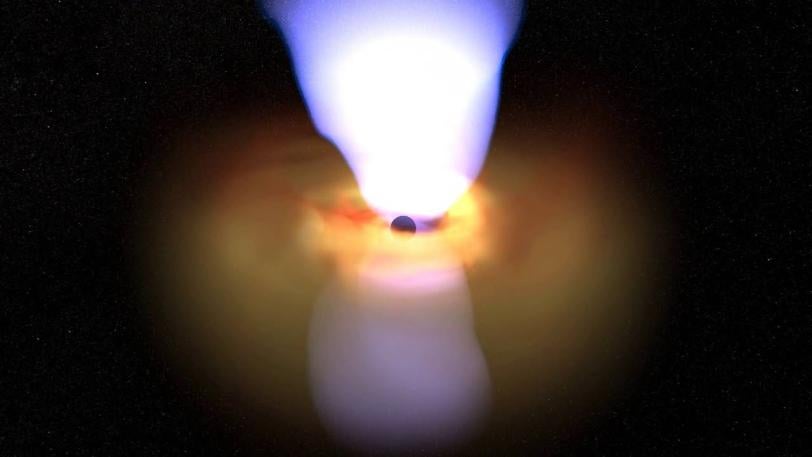
The result, especially in the case of a black hole with a thick accretion disk, is a complex maelstrom of interacting forces: Near the black hole, spiraling magnetic fields cause the material in the accretion disk to orbit about the black hole in the same direction as the black hole’s spin. Twisting lines of magnetic force launch two jets of particles in opposite directions at close to the speed of light. These jets, called relativistic jets, initially speed away parallel to the black hole’s axis of rotation – its north and south poles. But as gravity’s grip weakens, the charged gas in the outermost regions of the accretion disk pulls at the jets, pulling them away from the black hole’s rotational axis even as the jets collide with that gas and knock it away from the black hole.
Video

McKinney says the results of the simulations have direct consequences for studies of the delicate balance between how much gas a black hole can pull in from its accretion disk and how much gas it blows away with its jets. The greedier the black hole, the more gas it pulls in and the more energy is funneled to the jets, until they become so powerful they can blast the surrounding area clear – shutting down star formation in the vicinity – and, says McKinney, “The black hole stops its own growth.”

According to their simulations, the boost in energy provided by all the forces interacting around a black hole, including the magnetic force, makes a black hole even better at blasting its surroundings clear than currently thought. “Based on our study we’re saying there are some aspects of the feedback mechanism that we don’t understand,” McKinney said, and this remains a major unsolved problem in astrophysics.

Soon, though, the work of McKinney and his colleagues, Alexander Tchekhovskoy of Princeton and Roger Blandford, director of the Kavli Institute for Particle Astrophysics and Cosmology at SLAC and Stanford, may be confirmed by actual observation. A globe-spanning array of telescopes all acting as one called the Event Horizon Telescope has been making its first close-up observations of black holes – with some help, said McKinney, from their simulations. "Any interpretations are still very preliminary," he added, but the possibility that their ideas soon might face a direct test is exciting. 

More movies of the new black hole simulations are available on McKinney's YouTube page.


Contact

For questions or comments, contact the SLAC Office of Communications at communications@slac.stanford.edu.
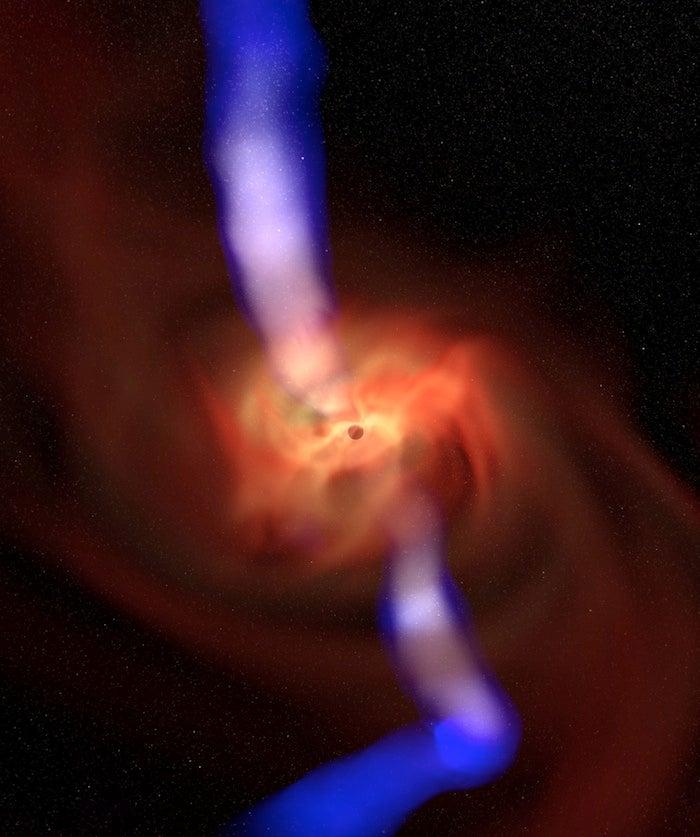
Image - Black hole simulation with accretion disk and...
Version 1: A spinning black hole (at center) produces a powerful jet (white-blue) along its spin axis. While near the hole, the disk rotational axis and jet direction are aligned with the black hole spin axis, but farther away the jet deviates and eventually points along the outer disk's rotational axis. (Credit: Jonathan McKinney, University of Maryland, and Ralf Kaehler, SLAC National Accelerator Laboratory)
Image - Black hole simulation with accretion disk and jet
Version 2: Spinning black hole (at center) produces a powerful jet (white-blue) along its spin axis. The jet affects the orientation of the surrounding accretion disk (infalling hot plasma as white-red near the hole) causing the disk to align with the spin axis near the hole, but at larger distances the disk dominates the jet and the jet re-aligns with the outer disk. (Credit: Jonathan McKinney, University of Maryland, and Ralf Kaehler, SLAC National Accelerator Laboratory)
Image - Black hole simulation with accretion disk and jet
Version 3: Spinning black hole (at center) produces a powerful jet (white smoke) along its spin axis. The jet affects the orientation of the surrounding accretion disk (infalling hot plasma as purple far from the hole and yellow near the hole) causing the disk to align with the spin axis near the hole, but at larger distances the disk dominates the jet and the jet re-aligns with the outer disk. (Credit: Jonathan McKinney, University of Maryland, and Ralf Kaehler, SLAC National Accelerator Laboratory)
Dig Deeper

Related stories

News Brief

The latest results combined weak lensing and galaxy clustering and incorporated four dark energy probes from a single experiment for the first time.

Photo of the Cerro Tololo Inter-American Observatory (CTIO) in the Chilean Andes at night.
Multimedia

His visit highlighted the breadth of our world-class research and the people and collaborations that make it possible. A key theme of the day...

U.S. Deputy Secretary of Energy Danly watches a simulation of dark matter.
News Release

The state-of-the-art ‘big-data facility’ unveils its first images and video, bringing the night sky to life like never before.

This image combines 678 separate images taken by NSF–DOE Vera C. Rubin Observatory in just over seven hours of observing time. Combining many images in this way clearly reveals otherwise faint or invisible details, such as the clouds of gas and dust that comprise the Trifid nebula (top) and the Lagoon nebula, which are several thousand light-years away from Earth
News Brief

The latest results combined weak lensing and galaxy clustering and incorporated four dark energy probes from a single experiment for the first time.

Photo of the Cerro Tololo Inter-American Observatory (CTIO) in the Chilean Andes at night.
Multimedia

His visit highlighted the breadth of our world-class research and the people and collaborations that make it possible. A key theme of the day...

U.S. Deputy Secretary of Energy Danly watches a simulation of dark matter.
News Release

The state-of-the-art ‘big-data facility’ unveils its first images and video, bringing the night sky to life like never before.

This image combines 678 separate images taken by NSF–DOE Vera C. Rubin Observatory in just over seven hours of observing time. Combining many images in this way clearly reveals otherwise faint or invisible details, such as the clouds of gas and dust that comprise the Trifid nebula (top) and the Lagoon nebula, which are several thousand light-years away from Earth
Feature

NSF–DOE Vera C. Rubin Observatory is about to embark on its quest to capture the cosmos, marking the culmination of decades of work by...

A group photo in front of a large telescope mounting system.
Feature

NSF–DOE Vera C. Rubin Observatory will add an unprecedented amount of cosmological data to the study of the structure and expansion of the Universe.

An illustration of a woman holding a book is surrounded by photographic negatives showing pictures of the universe.
News Brief

Wechsler is one of seven Stanford researchers to join the scholarly society, which works to promote science for public good.

Risa Wechsler